

How accurate is Total Load?
Total Load uses published research on how much body weight each move lifts. The figures are averages, so your own load can differ a little.
Total Load depends on two inputs: your body weight and the share of it each move lifts. The share comes from published biomechanics research, mainly Ebben and colleagues (2011) for the push-up family, with related studies for pulling and squatting moves. A standard push-up lifts about 64% of your body weight, a dip about 98% and a pull-up all of it. Where studies are thin, as with stretches, Kinoku picks a careful middle value.
The chart, your records and your muscle volume all use the same formula, so the numbers agree across the app. The shares are averages, however, and your arm and leg length, your tempo and how deep each rep goes will shift your real load a little.
Your body weight matters as much. Kinoku uses the latest reading it has, so an old reading makes the load less exact. If the share for a move looks wrong for you, you can change its percent in the exercise editor.
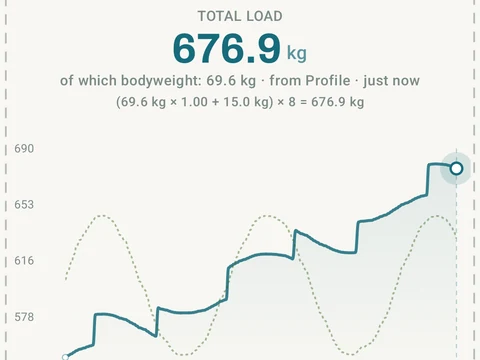
In the app
Bodyweight Total Load
Pull-ups, push-ups, and dips get real per-rep load from body-movement math, not just reps times one. The load math, snapshots, and Total Load chart are free; Pro scales the volume charts in Stats Analysis to your body weight.