

How accurate are the ovulation and fertile-window predictions?
It depends on what you log. Dates alone give a rough guess, and adding temperature, cervical mucus or ovulation test results makes the estimate firmer.
How close a guess gets depends on what you log. With dates alone, Kinoku works from your cycle length and the days from ovulation to your next period. That gives a rough guess, with a confidence of about 40 to 60 percent. Each extra sign you log makes the guess firmer:
- Cervical mucus, from your peak egg-white day: about 60 to 75 percent.
- Basal body temperature (BBT), from the rise after you ovulate: about 70 to 85 percent.
- Luteinizing hormone (LH) tests, from the surge: about 85 to 95 percent.
- All three signs read together, which Kinoku calls symptothermal, when two or more agree: 90 percent or more.
Your fertile window is the five days before ovulation plus the day itself. Peak fertility is the day before ovulation. The card that shows these dates also names the method behind them and how sure it is, and the info sheet lists these ranges.
A rise in temperature confirms ovulation only after it has happened. Every number here is a guess. Kinoku is not a medical device, and its dates are not a form of birth control.
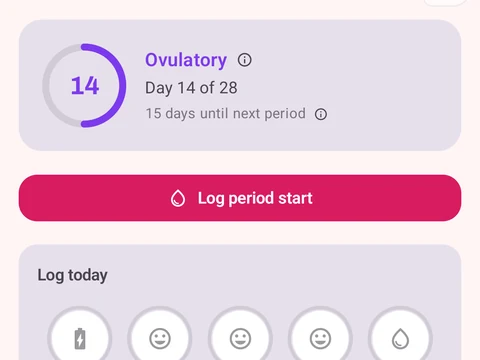
In the app
Cycle Tracking & Fertility
Full cycle, fertility, and pregnancy tracking, with phase context and training links. Dedicated raw records and generated cycle state are excluded from future Android automatic cloud backup, standard exports, share cards, and Kinoku servers. Your Cycle Tracking configuration lives in that same excluded database, while user-created metrics remain eligible for Android system backup in your Google account. A manual ZIP or user-initiated device transfer can carry the dedicated database.