

Pace, splits and race estimates
Running Pace Calculator
A 25-minute 5K works out to 5:00 per kilometre. You can enter your own time below, or choose a pace to see when you'd finish.
Work out the missing number
Even splits
These times assume you hold the same pace from start to finish. If the distance ends partway through a kilometre or mile, the last split is shorter.
| Distance | Split time | Elapsed time |
|---|
What about a different race?
This uses the time and distance above; a recent race is a better starting point than an easy run.
The ±5% range is illustrative, using the app's single-model fallback rule. Your finish can fall outside it; this isn't a personal confidence interval.
A bigger jump in distance leaves more room for error, especially from a short race to a marathon.
What does my pace result mean?
Pace is how long you take to cover one kilometre or mile, so a lower number means a faster run. The converter works this out exactly from your entries, then rounds it for display. A race forecast goes further: it guesses how well you'll hold that speed over a different distance.
For a 25-minute 5K, the third kilometre arrives at 15:00 if you keep an even pace. Holding that pace can feel quite different in hot weather; the heat and dew point pace tool looks at that part of the run.
The pace and race-time formulas
Pace = total time ÷ distance
Time = pace × distance
Distance = total time ÷ pace
Predicted time = source time × (target distance ÷ source distance)^1.06
Pete Riegel's formula starts with a race you've done and scales its time to another distance, using an exponent of 1.06. Kinoku uses that exponent too. For unit changes, one mile is exactly 1.609344 km, and a marathon is 42.195 km.
Riegel's 1981 paper describes the model, while his own later notes give it a range of one mile through a marathon. Outside those distances, this page still converts your pace but leaves the race forecast blank.
Vickers and Vertosick's 2016 study found that Riegel often gave recreational runners marathon times they couldn't match. The study mainly used 1.07, while this page uses 1.06, so its errors don't provide a measured range for this calculator.
The race pace explainer has a worked example, along with the difference between picking a target and predicting a finish. The marathon pace chart lists every finish from 2:30 to 6:00 with its pace and its splits at 5 km, 10 km, halfway, 30 km and 20 miles.
Boston qualifying times for 2027
Registration closed on September 18, 2026. The September 29 update put the acceptance cutoff at 5:17 faster than the standard, so the times below alone weren't enough for entry.
The Boston Athletic Association's official page is the source for these times, checked on October 7, 2026. The rules use your age on race day, April 19, 2027, and your official chip time.
| Age | Men | Women / non-binary |
|---|---|---|
| 18–34 | 2:55:00 | 3:25:00 |
| 35–39 | 3:00:00 | 3:30:00 |
| 40–44 | 3:05:00 | 3:35:00 |
| 45–49 | 3:15:00 | 3:45:00 |
| 50–54 | 3:20:00 | 3:50:00 |
| 55–59 | 3:30:00 | 4:00:00 |
| 60–64 | 3:50:00 | 4:20:00 |
| 65–69 | 4:05:00 | 4:35:00 |
| 70–74 | 4:20:00 | 4:50:00 |
| 75–79 | 4:35:00 | 5:05:00 |
| 80+ | 4:50:00 | 5:20:00 |
Meeting the standard let a runner apply; race staff still had to review the application and check the time. The Boston qualifying times page adds the pace each standard needs, the time 5:17 under it and the cutoff history since 2012.
How the 2027 downhill adjustment works
The rule counts the drop from the start line to the finish line, without adding up the descents in between.
| Net drop in feet | Time added for review |
|---|---|
| Below 1,500 | None under this rule |
| 1,500–2,999 | 5:00 |
| 3,000–5,999 | 10:00 |
| 6,000 or more | Course ineligible |
Race staff add the adjustment after an application is submitted, so the chip time alone may look faster than the qualifying time.
Privacy
The maths happens in your browser, and changing an input makes no network requests. Your entries aren't stored or sent anywhere, and you can use the calculator without an account.
Race estimates from your run history
If you're following a race goal for a while, you can look back through your runs in Kinoku. Running Progress is free, while Race Predictions is part of Pro and uses the run history on your phone.
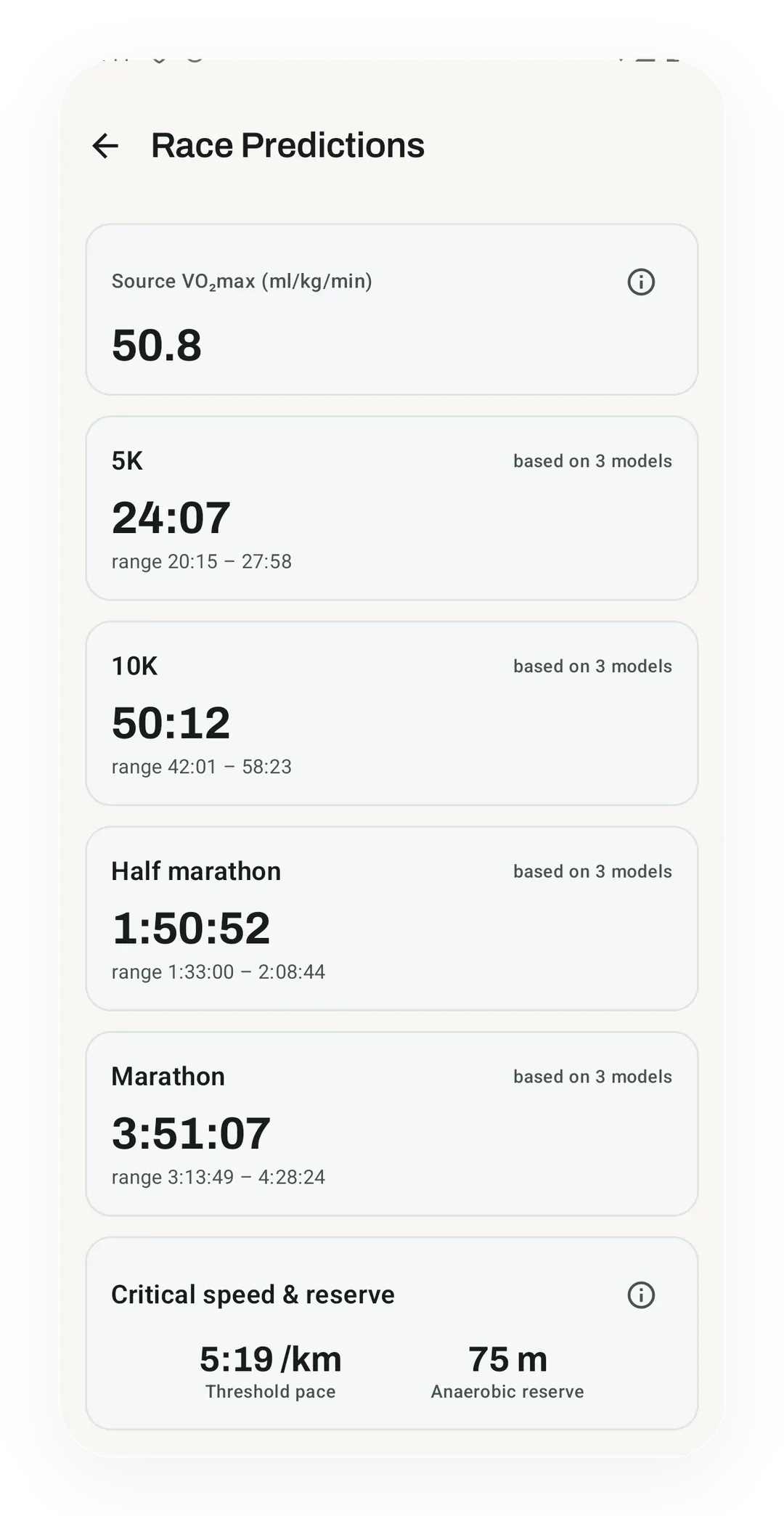
Running → Race Predictions
Race Predictions shows four distances together, with a range and a count of the models used for each estimate. Given enough run data, Kinoku can combine more models than this page uses, so the times can differ.
ProPart of Pro; recording your runs is free.
Kinoku is an Android app, and it works out these estimates on your phone without an account.
Common questions
What pace is a 25-minute 5K?
At 5:00 per kilometre, or about 8:03 per mile, you would finish a 5K in 25 minutes. The split table follows that pace through each kilometre, reaching the finish at 25:00.
Is the race prediction range a confidence interval?
We show five percent either side of the Riegel estimate as an illustrative range, using the same rule as the app's single-model fallback. It isn't a personal confidence interval, and your finish can fall outside it.
Why does a marathon prediction look too fast?
Your 5K time says something about your speed, but less about how you'll hold up over a marathon. The bigger the jump in distance, the more your endurance training and the conditions on race day matter.
Is registration for the 2027 Boston Marathon still open?
Registration closed on September 18, 2026, and accepted qualifiers ran at least 5:17 faster than their age and gender standard. The table below is a reference for the 2027 race, with the official source beside it.
Does this calculator save my run time?
Your time stays in this browser tab, and changing the inputs makes no network requests. The calculator doesn't store or send your entries anywhere, so opening it again brings back the example values.