

Dumbbell Stopgap: Free Beginner Dumbbell Program
Kinoku's free plan based on the r/Fitness Dumbbell Stopgap: one full-body dumbbell workout on three days, and reps that go from 8 to 12 before weight goes up.
Weekly Training Schedule
These are the sessions the Kinoku template builds when you start it, and the same sessions sit in the file below. The rep counts are each routine's starting targets. For the goblet squat, dumbbell Romanian deadlift, dumbbell bench press, dumbbell row and dumbbell shoulder press, the template works out the first weights from your one-rep max and moves the weight or reps after each session.
- Goblet Squat3 x 8
- Romanian Deadlift (Dumbbell)3 x 8
- Bench Press (Dumbbell)3 x 8
- One-Arm Dumbbell Row3 x 8
- Shoulder Press (Dumbbell)3 x 8
- Plank3 x 45 s
- Goblet Squat3 x 8
- Romanian Deadlift (Dumbbell)3 x 8
- Bench Press (Dumbbell)3 x 8
- One-Arm Dumbbell Row3 x 8
- Shoulder Press (Dumbbell)3 x 8
- Plank3 x 45 s
- Goblet Squat3 x 8
- Romanian Deadlift (Dumbbell)3 x 8
- Bench Press (Dumbbell)3 x 8
- One-Arm Dumbbell Row3 x 8
- Shoulder Press (Dumbbell)3 x 8
- Plank3 x 45 s
Ready to lift?
Start Dumbbell Stopgap in Kinoku
Dumbbell Stopgap is a free template in the app. When you start it there, Kinoku builds the routine and puts 12 weeks on your calendar. It also works out the first weights for the goblet squat, dumbbell Romanian deadlift, dumbbell bench press, dumbbell row and dumbbell shoulder press from your one-rep maxes.
Any time, from the menu
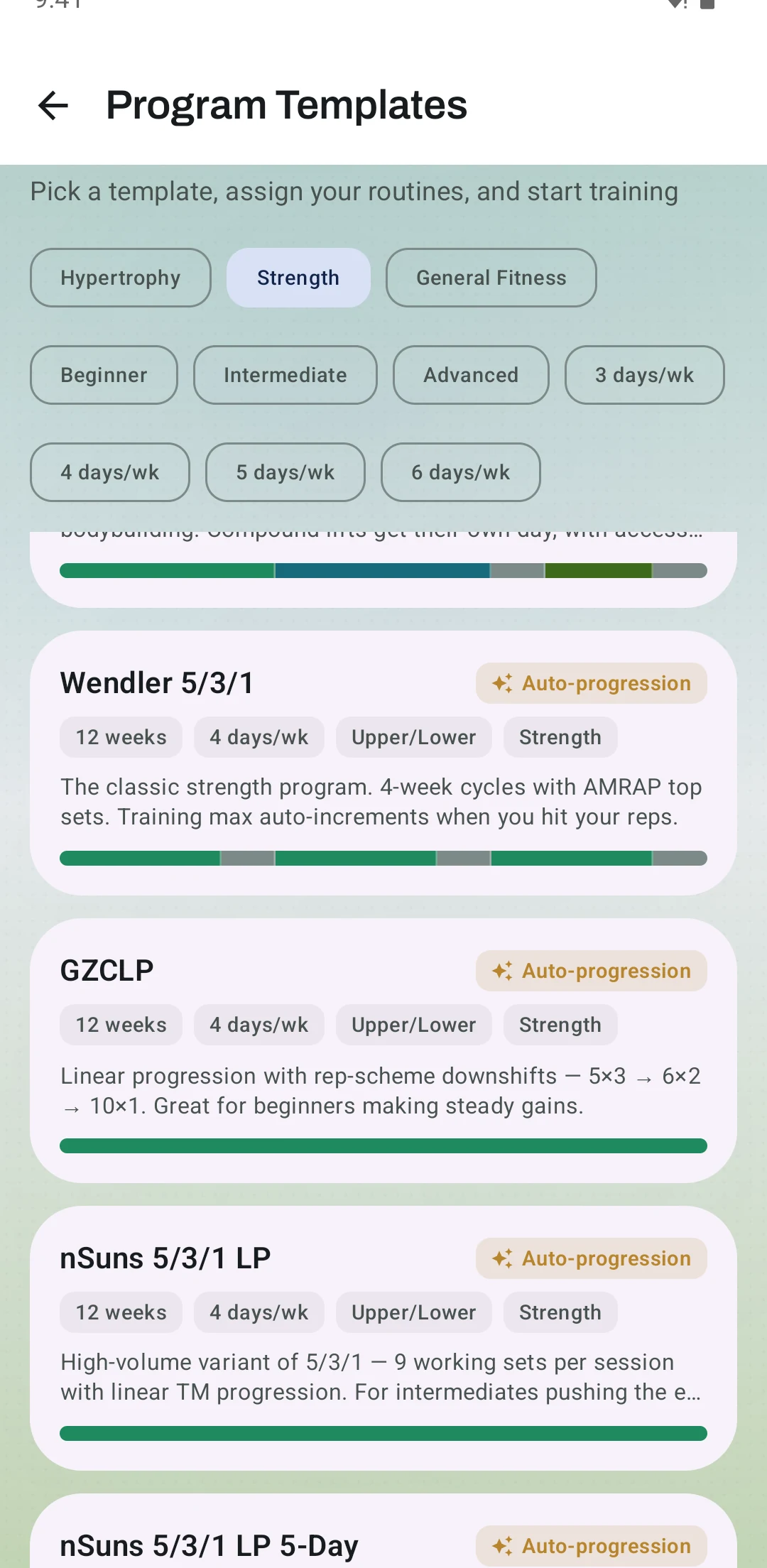
- Open the menu, tap Search Kinoku at the top, type templates and tap Program templates.
- Tap the Hypertrophy filter to shorten the list, then tap Dumbbell Stopgap (r/Fitness) and Start This Program.
- Choose a start date, tap Next, and tap Create the program routines so Kinoku builds the routines for you.
- Tap Next, then Activate Program, and enter your one-rep max for each lift it lists before you tap Start program.
On your first launch, from the welcome screen
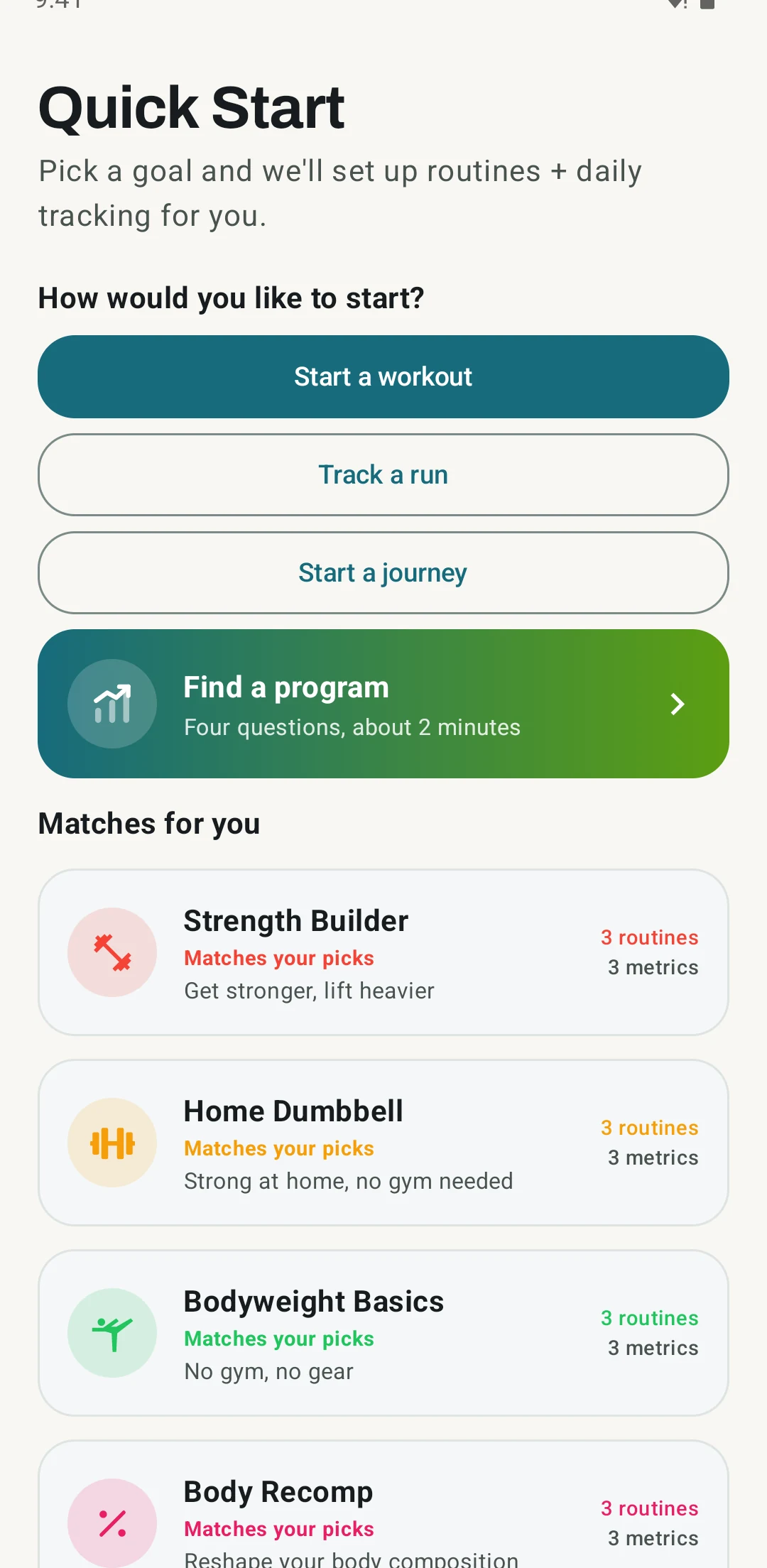
- Pick Strength as a focus, because the finder card only shows for people who lift.
- Tap Find a program on the welcome screen, right under the three start choices.
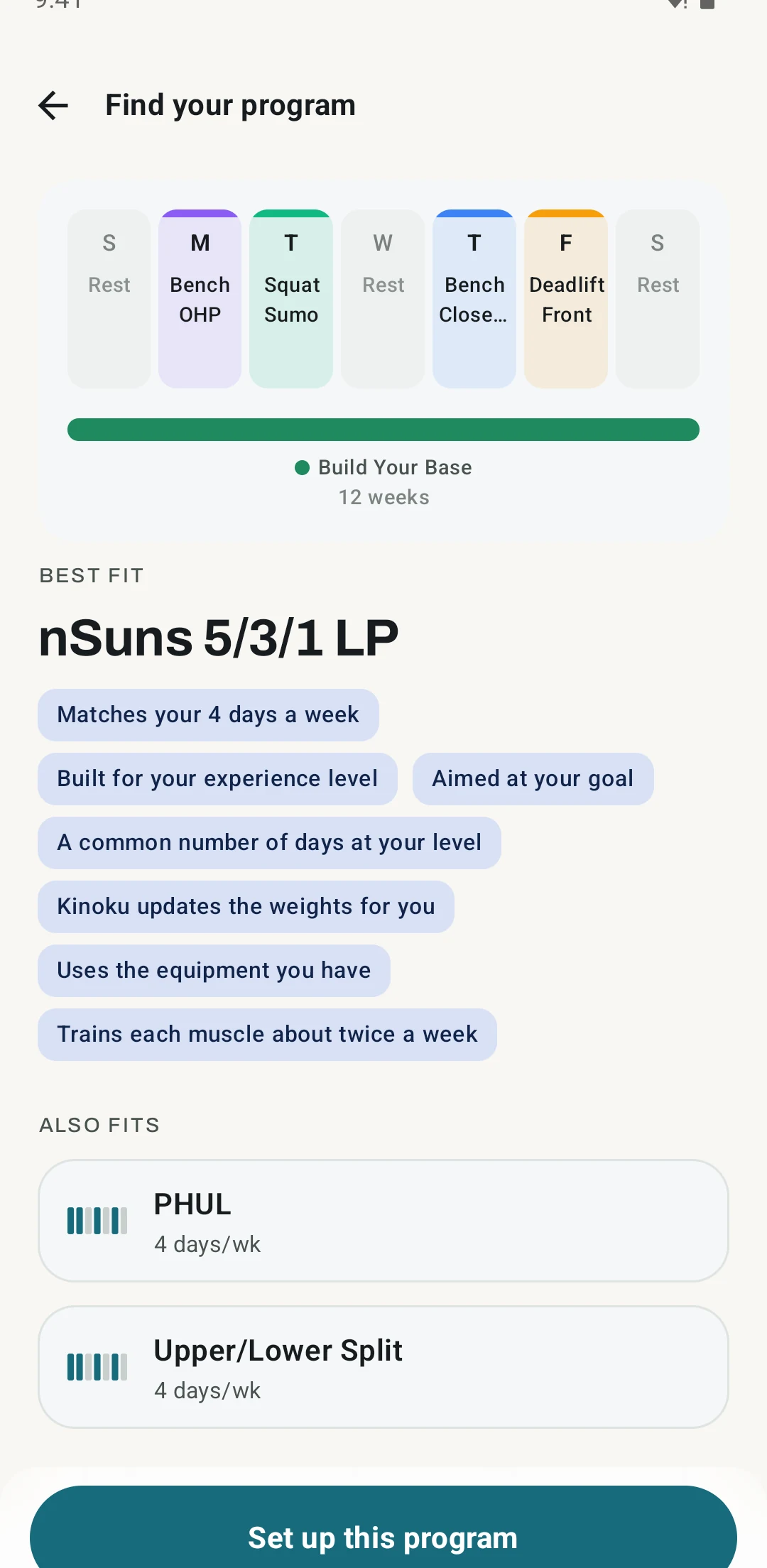
- Answer four questions about your week, and the finder sets up the match for you.
The finder picks the program that fits your answers, so it can suggest a different one, while the menu path above reaches Dumbbell Stopgap every time.
Opens the template in the app when Kinoku is installed, and opens Google Play when it is not.
Prefer a file?
Save the file, then open it with Kinoku, and you get 1 routine and a 12-week calendar that starts on the Monday after you download it. No workouts are added to your history, and the file does not work out loads from your one-rep max.
Kinoku in practice
Track this program on your phone
 Open full-size image ↗
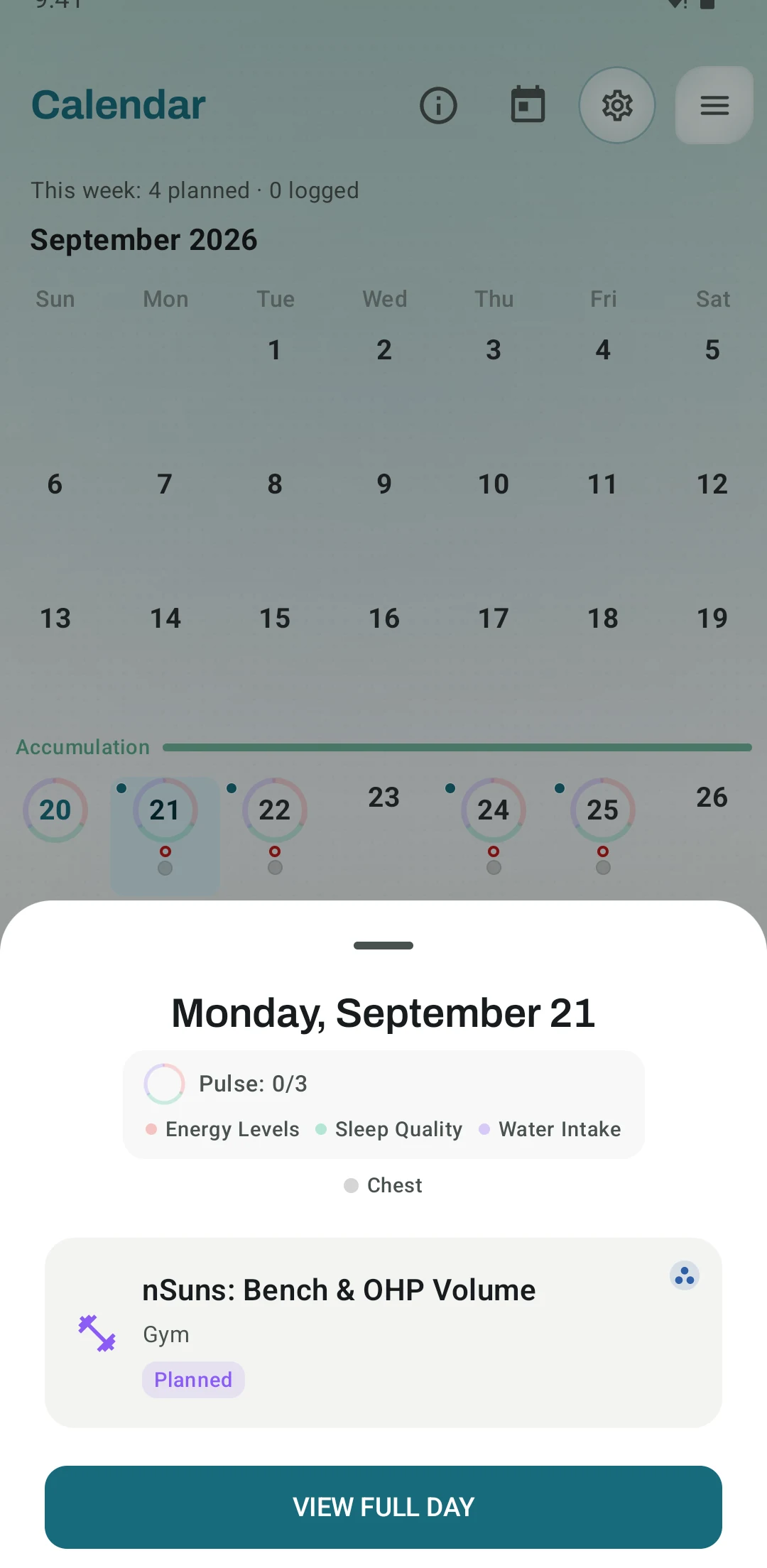
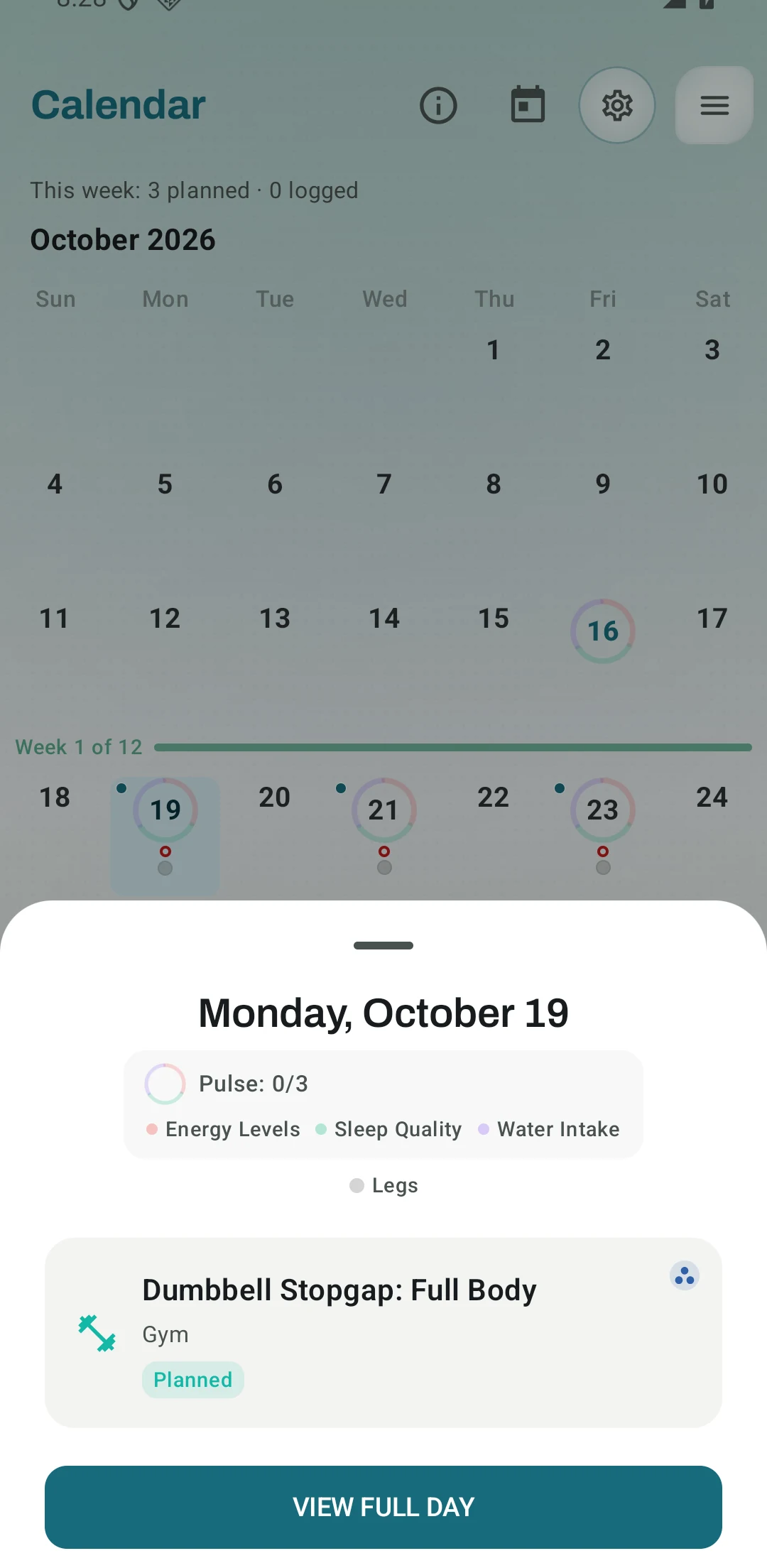
Your weeks land on the calendar
Real Android app capture of the Dumbbell Stopgap set to start on a Monday. Its one full-body session, Dumbbell Stopgap: Full Body, lands on Monday, Wednesday and Friday.
 Open full-size image ↗
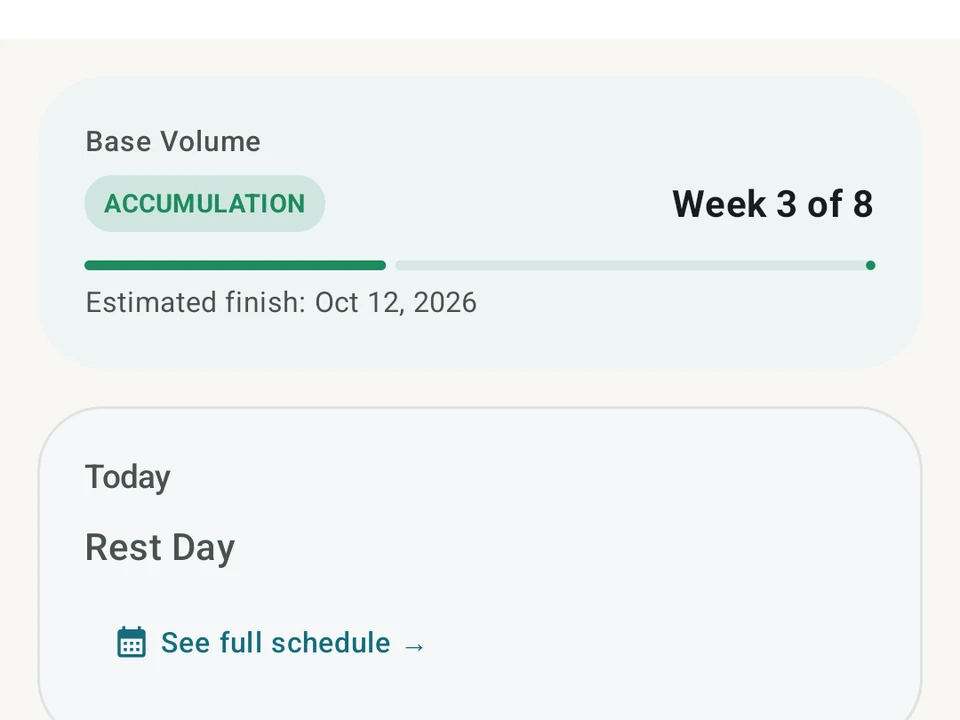
Your week in the program
Real Android app capture of the program dashboard, from an 8-week template. The Dumbbell Stopgap tracks its progress on the same card, out of 12 weeks.
The Dumbbell Stopgap is a three-day dumbbell program that a Reddit user, u/Cammorak, posted to r/Fitness for lifters whose gym has dumbbells and no barbells. The Fitness Wiki keeps the original post in its archive. As its name says, the program is meant to fill a gap until you can train with a barbell, follow a bodyweight program or set up a home gym.
How the original program works
The original has two workouts that take turns over three days a week, with A, B and A in the first week, then B, A and B in the next. Both start with a Bulgarian split squat or a lunge and end with a plank. Workout A has a floor press and a straight-legged deadlift in between, and Workout B has a seated shoulder press and a standing bent-over row with two dumbbells.
Every exercise except the plank is three sets of up to 10 reps, with a minute of rest between sets. Three sets of 10 earn the next dumbbell up at the following workout. Three workouts stuck at the same reps and weight move the lift two steps lighter so it can build up again, and the plank is held for as long as you can.
The post asks for a range of dumbbells, usually in 2.5 or 5 lb steps, or an adjustable pair. It also says the program is not meant for someone with a single pair of fixed dumbbells.
What Kinoku works out for you
Kinoku runs one full-body routine, Dumbbell Stopgap: Full Body, on Monday, Wednesday and Friday. It holds a goblet squat, a dumbbell Romanian deadlift, a dumbbell bench press, a one-arm row and a dumbbell shoulder press, each for three sets of 8, then three planks of 45 seconds.
The five dumbbell lifts climb through a rep range before they get heavier. Each session where all three sets reach the target adds one rep to it at the same weight, from 8 up to 12. After a good session at 12 reps, the dumbbells go up 2 kg and the target drops back to 8.
Take a dumbbell bench press with 14 kg dumbbells as an example. Good sessions move the target from 8 to 9, 10, 11 and 12, and after three sets of 12 the next session plans 16 kg dumbbells for sets of 8. Three missed sessions in a row take about 10 percent off the lift, rounded to a 2 kg step, and the target goes back to 8.
When you start the template, you can enter a one-rep max for each lift, and Kinoku plans 65 percent of it, rounded to a 2 kg step. A field left blank starts that lift at 7.5 kg a dumbbell, and its first step up goes to 10 kg.
Where the app’s version differs
Kinoku trains every lift in every session, where the original splits them across two workouts. The exercises differ too. Kinoku uses a goblet squat in place of the split squat or lunge and a bench press for the floor press. A Romanian deadlift stands in for the straight-legged deadlift, and a one-arm row replaces the row with two dumbbells.
The rep range runs to 12 where the original stops at 10, and each weight step is a fixed 2 kg where the original moves up one dumbbell. A stall in Kinoku takes about 10 percent off after three missed sessions, while the original drops two dumbbell steps after three stuck workouts. The plank has a 45-second target instead of a hold for as long as you can, and the optional dips and pull-ups are not in the routine.
Because Kinoku plans the weights in 2 kg steps, a rack that goes up in 2.5 kg steps means picking the nearest pair. That step is fixed by the template, and the Smaller setting under Weight jumps does not shrink it.
When the stopgap ends
The post says the program runs out when your dumbbells do, and it hopes you move on to a barbell or bodyweight program before then. Kinoku plans 12 weeks. With a barbell, the Classic 5x5, Greyskull-style and Basic Beginner Routine pages each describe a three-day plan. With the same dumbbells and more time, Kinoku’s Dumbbell PPL (push, pull and legs) trains six days a week, as its program page shows.
Frequently asked questions
What app can run a beginner dumbbell program for me?
Kinoku's free Dumbbell Stopgap plan runs one full-body routine on Monday, Wednesday and Friday. Each of the five dumbbell lifts gains a rep after a good session, from 8 up to 12, and then the dumbbells go up 2 kg as the target drops back to 8. Three missed sessions in a row take about 10 percent off that lift.
What equipment does the Dumbbell Stopgap need?
It needs a range of dumbbells or an adjustable pair, and Kinoku's version also uses a flat bench for the dumbbell bench press. The original post rules out a single pair of fixed dumbbells, because the program depends on moving up one step at a time.
How do the reps and weights go up in Kinoku?
Each good session adds one rep to the target, from 8 up to 12, at the same weight. After three sets of 12, the next session plans heavier dumbbells and goes back to sets of 8. Each step adds 2 kg, except that a lift left blank at the start goes from 7.5 kg to 10 kg on its first step. The 2 kg step is fixed, so a rack that moves in 2.5 kg steps does not match it exactly.
Why is it called a stopgap?
The author wrote it as a way to start training right away while you wait for a barbell, a home gym or a bodyweight program. The post says the program has a short shelf life, and that it ends when your dumbbells run out.
Do I need a one-rep max for dumbbell lifts?
No, because a field left blank starts that lift at 7.5 kg a dumbbell. A one-rep max sets the first weight at 65 percent of it instead, rounded to a 2 kg step.
Calculators & tools
Compare Epley and Brzycki estimates, then print percentage and rep-max charts in kilograms or pounds.
Every exercise in Kinoku's catalog as a star in 3D, placed by the muscles it works. Search a move to see its muscle map, or pick muscles to rank the moves that focus on them.
Fat-Free Mass Index. It gauges how much muscle you carry. The adjusted form corrects for height.
Track this in the app
Run Dumbbell Stopgap in Kinoku
Kinoku works out the weights and the jumps for the lifts it tracks, offline on your phone.
100% free with no mandatory account and no cloud tracking.
Related app features
A 4-phase planning stack. The builder, all 25 templates, named programs with auto-progression, the custom model, and unlimited active programs are free. Pro adds volume targets, readiness tuning, and auto set changes.
Unlimited routines, Smart Sync, Starter Packs, and follow-along links are free, and so are Rotation Groups that cycle through several routines for you.
1,300+ built-in exercises with muscle data and unlimited custom moves are free. Pro adds custom form photos and assisted sorting.
Open a lift in Stats and a plain label says if it is progressing, holding steady, or slipping, with a flat-zone band on the chart. The label is free. Pro adds ideas for a stuck lift (options, never orders), an all-lifts dashboard, and a Coach card. It stays quiet when the data is thin.