

Best apps to compare your runs on Android (2026)
Eight Android run apps checked for how they set one run against another, grouped by the kind of comparison, quoted from each app's own pages.
Kinoku, Runalyze, Runkeeper and Strava are the apps whose own pages describe putting one of your runs next to another, and all four keep that in a paid plan; FitoTrack, Garmin Connect, Nike Run Club and OpenTracks read each run on its own.
Kinoku's run compare, filmed in the app
We filmed these clips in Kinoku 1.6, the release that rebuilt the compare around who was ahead. Comparing two runs is part of Kinoku Pro, and the free plan gets the short preview in the third clip.
At a glance
| App | Best for | Better at | Main trade-off |
|---|---|---|---|
| Kinoku | Runners who want a deep free read of each run and a side-by-side compare with no account | Nine free charts per run, plus a ghost compare that lines two runs up by distance | Comparing two runs is Pro, and it is Android only |
| Runalyze | Runners with a watch who want analysis of races and repeated routes on the web and the phone | Recurring routes, performance curves and a chart that compares race results | Needs a Runalyze account, records nothing itself, and recurring routes are Premium |
| Runkeeper | Runners who want a comparison of their workouts inside a plain run tracker | A named Workout Comparison next to training plans in one subscription | Compare workouts sits in Runkeeper Go, and it asks for a OneASICS account |
| Strava | Runners who want a pace trend on a usual route and segment rankings against other people | Matched Activities charts your runs on a repeated route, and segments rank you against others | Matched Activities and segment rankings are for subscribers |
| FitoTrack | Runners who want a private log with open code and a speed chart for each run | No account, no ads and open code, with a speed diagram per workout | Its pages describe no run-to-run comparison |
| Garmin Connect | Garmin watch owners who want their runs and health data in one app | Detailed activity statistics, courses and rankings with friends | Needs a paired Garmin device, and its listing names no run-to-run compare |
| Nike Run Club | Runners who want guided runs and personal bests with badges | Guided runs for race distances and trophies for personal bests | Its listing names no comparison of one run with another |
| OpenTracks | Runners who want detailed stats per track with no internet access at all | No internet permission, open code and track export to KMZ, KML or GPX | Its pages describe no run-to-run comparison |
Publisher disclosure
Kinoku, made by Dreamsoft Works, writes and publishes this page, and Kinoku is one of the apps on it. Every fact about another app is quoted from a page that app's maker publishes, opened on October 17, 2026. We give no score. The caption names how the list is grouped, and every label points at a quoted sentence.
Quickstart
Kinoku, Runalyze, Runkeeper and Strava describe putting one of your runs next to another, and each keeps that comparison in a paid plan. Strava also ranks your effort against other runners on segments. FitoTrack, Garmin Connect, Nike Run Club and OpenTracks read each run on its own, and their pages describe no run-to-run comparison. The apps are grouped by the kind of comparison, A to Z inside each group.
What kind of comparison does each app make?
“Compare my runs” can mean more than one thing, and the eight apps here split into two groups by what their own pages describe.
- One of your runs against another: Kinoku, Runalyze, Runkeeper and Strava. Runkeeper’s Go page promises a way to “see how your runs stack up to each other”, Runalyze lists “Recurring routes per sport”, and Strava groups runs on a repeated route into one chart. Kinoku draws a second run as a ghost on every chart.
- Each run on its own: FitoTrack, Garmin Connect, Nike Run Club and OpenTracks. Each one shows a run in detail, from FitoTrack’s speed diagram to Garmin’s “detailed statistics”, but none of the pages we read sets two runs side by side.
The paid part matters here. Every app whose pages name a run-to-run comparison keeps it behind a subscription, Kinoku included. Strava also offers a second kind of comparison, segments that rank your time on a stretch of road against other runners, and its full leaderboard sits in the subscription too.
Side by side
Each row below rests on the app’s own pages. “Not stated” marks a point that none of those pages covers, and Kinoku’s row rests on its code and feature pages.
| App | Compares one run with another | Where that sits | One run in depth | Account to start |
|---|---|---|---|---|
| Kinoku | Ghost compare with a Lead chart, Similar Runs, live ghost on Run Again | Pro | Nine charts and auto marks, free | No |
| Runalyze | Recurring routes; race results on a chart | Recurring routes in Premium | Route map, plots and laps | Yes, and it records nothing itself |
| Runkeeper | Compare workouts | Runkeeper Go | Basic stats free | Yes |
| Strava | Matched Activities on a repeated route; segments against other people | For subscribers | Not stated beyond the subscription list | Yes |
| FitoTrack | Not stated | Not stated | Speed diagram and route map | No |
| Garmin Connect | Not stated | Not stated | Detailed statistics | Yes, plus a Garmin device |
| Nike Run Club | Not stated | Not stated | Speed, elevation and heart rate | Not stated |
| OpenTracks | Not stated | Not stated | Detailed recorded statistics | No |
Each app, in its own words
Kinoku
Best for: Runners who want a deep free read of each run and a side-by-side compare with no account.
Kinoku is an Android training app for lifting and running that never asks you to sign up. Your runs live on your phone and on no Kinoku server, though Android’s own backup can include eligible app data.
- What it does well for free: Run Studio stacks pace, heart rate and elevation on charts that zoom together, with nine cards below them. They cover a peak pace curve, a lap grid, a hill chart and a fade chart. Kinoku pins marks on the charts, such as your fastest 5 km inside the run and the point where fatigue set in.
- Comparing runs, on Pro: Last time and Your best are one tap each, and the other run appears as a faint ghost on every chart. A Lead chart shows how many seconds you were ahead or behind along the route, and the map colors the route by who was ahead. You can line the two up by time or by distance. The Similar Runs card on a run summary sets the run against your others of a close distance, with pace adjusted for hills, and a row on it opens the compare on the map.
- Racing your old self, on Pro: A Run Again button on a past run starts a new one with the old route and pace drawn live, so you see during the run whether you are ahead.
- What Kinoku does not do: Kinoku has no segments and no leaderboard against other runners, and no iPhone version yet. The run-to-run compare, replay and the Route Heatmap are all Pro.
Running Progress, the free screen for your records and trends, stays quiet until your history can back a claim that you are faster. You can install Kinoku from its official Google Play listing.
Runalyze
Best for: Runners with a watch who want analysis of races and repeated routes on the web and the phone.
Runalyze is a training analysis service with a website and a phone app. Its listing is plain about the setup: “a Runalyze account is required. The app does not record activities itself.” Runs reach it from a watch service you link or from files you upload.
- What it does well: Its homepage says that “With the help of our performance chart you are able to compare all your competition results regarding age grade, effective VO2max or speed”, where VO2max means your top rate of oxygen use. It also shows performance curves for pace, heart rate and power over your last 90 days.
- What its pages say about comparing runs: The listing names “Best sub segments by distance, time and power” and “Recurring routes per sport”, which is the closest it comes to a same-route compare.
- What its pages say about limits: “Some features such as the tiles counter, recurring routes and injury tracking are part of Runalyze Premium.” The homepage also lists best segments and pace-colored tracks under Runalyze Premium.
- Where it is the better pick: A runner who already records on a watch and wants race results and repeated routes broken down on a big screen.
The official Runalyze app is on Google Play.
Runkeeper
Best for: Runners who want a comparison of their workouts inside a plain run tracker.
Runkeeper is a GPS run tracker owned by the shoe maker ASICS (a Japanese sports brand), with a paid tier called Runkeeper Go. Its listing promises “Activity Insights” to “see how your runs improve and get a full view of your fitness journey.”
- What it does well: Its Go page names a feature called Workout Comparison, which gives “immediate feedback on your performance” and shows “how your runs stack up to each other.” Training plans and live tracking come in the same subscription.
- What its pages say about limits: The Go page’s plan table ticks only tracking and basic stats in the free Basic column, and Compare workouts is ticked in the Runkeeper Go column. Its help centre says a new user is asked to sign up for a OneASICS account or log in.
- Where it is the better pick: A runner who wants plans, live tracking and a workout compare under one subscription from a large running brand.
The official ASICS Runkeeper listing is on Google Play, and our Runkeeper alternatives page covers its free plan in more depth.
Strava
Best for: Runners who like to measure a stretch of road against other people.
Strava is a social run and ride tracker with two ways to compare. Matched Activities groups your runs on a repeated route, and segments rank your time on a set stretch of road against other people.
- What it does well: Its help article says “The matched activities feature lets Strava subscribers benchmark themselves against past performances on their most common, personalized routes.” A chart then shows how your average pace on that route has moved over time.
- Against other people: Its listing says you can “Race against others on segments to the top of the leaderboards.” The same listing splits Strava into a free version and a paid subscription with extra features.
- What its pages say about limits: The subscribe page names “segment leaderboards, advanced training analysis and more” among the paid features, together with a way to “Measure effort across activities”. On the listing, Training Log & Best Efforts and Live Segments sit under the subscription heading.
- Where it is the better pick: A runner who wants a pace trend on their usual loop and also enjoys ranking against neighbors on a local hill.
Its terms say you must create an account to use it. The official Strava listing is on Google Play, and Kinoku vs Strava sets the two apps side by side.
FitoTrack
Best for: Runners who want a private, open-source log with a speed chart for each run.
FitoTrack describes itself as “a mobile app for logging and viewing your workouts.” Its listing adds: “It is open-source and completely ad-free.”
- What it does well: Each workout shows date, time, distance, speed and pace with the route on a map. Its listing says you can “Work out your level of performance from the speed diagram.”
- What its pages say about limits: None of its pages we read sets two runs side by side, so comparing means opening one run, then the other.
- Where it is the better pick: A runner who wants a clean record with no account and no data collected, and who reads runs one at a time.
Its data safety section says “No data collected”. FitoTrack’s official listing is on Google Play.
Garmin Connect
Best for: Garmin watch owners who want their runs and health data in one app.
Garmin Connect is the phone app that goes with Garmin watches and other Garmin devices. Once your phone is paired with a compatible Garmin device, its listing says, “you can review your tracked activities and health metrics.”
- What it does well: Its listing says “Analyze your activities with detailed statistics”, and “you can create workouts, build courses and challenge your friends on the leaderboard”.
- What its pages say about limits: The listing names no tool that sets one run against another on the phone. It also assumes a Garmin device, so it is no use as a phone-only run tracker.
- Where it is the better pick: A runner who already wears a Garmin watch and wants the phone side of it.
Garmin Connect’s official listing is on Google Play.
Nike Run Club
Best for: Runners who want guided runs and personal bests with badges.
Nike Run Club is a run tracker built around guided audio runs. Its listing says you can “Track cardio, running speed, GPS, elevation, heart rate & more”.
- What it does well: It offers a “Mobile running coach - Monitor fitness progress with your own virtual running coach”, and you “Earn badges and trophies for streaks and personal bests”.
- What its pages say about limits: The listing names personal bests but no tool that puts two runs side by side.
- Where it is the better pick: A newer runner who wants a voice in the ear on race-distance plans and a trophy when a best falls.
Nike Run Club’s official listing is on Google Play.
OpenTracks
Best for: Runners who want detailed stats per track with no internet access at all.
OpenTracks is an open-source sport tracker published on F-Droid. Its page lists “No Internet access or extra permissions.”
- What it does well: It says you can “Keep recorded statistics in great detail for analysis.” You can “Export data as tracks either as KMZ (incl. photos), KML, or GPX”, which lets you move a track to another tool.
- What its pages say about limits: None of its pages we read describes a comparison of two tracks.
- Where it is the better pick: A runner who wants the strictest privacy on the phone and is happy to read each track alone, or to export it elsewhere.
OpenTracks’ official page is on F-Droid, and our list of free run trackers with no account covers it next to FitoTrack.
What makes a fair comparison of two runs?
Two runs rarely match on more than distance, so a fair compare needs the right baseline. Three choices decide how much the result means.
- Same route or close distance: A same-route compare holds the hills and turns steady. Kinoku’s compare list puts runs on the same route first, then runs of a close distance, and Runalyze groups recurring routes on Premium. Strava’s Matched Activities does the same for subscribers, and a segment holds one stretch steady across many people.
- Line up by distance, not only by time: Lined up by time, the two lines show the same minute of each run. Lined up by distance, a hill at the 2 km mark sits in the same place on both lines, which is how Kinoku’s ghost compare lets you choose. GPS also wanders a few meters to each side, so the distance each run adds up can drift apart. Since version 1.6, Kinoku measures both runs along one shared line of the course, so that wobble does not fake a lead.
- Account for hills and heat: Kinoku’s Similar Runs card adjusts pace for hills. Heart rate is a harder signal to judge, since it drops when you are rested or cold, so Kinoku shows heart rate gaps without calling them good or bad.
No app can tell you why a run went well. A quick 5 km after a week off and a quick 5 km in a heavy training block read the same on every chart here, and the reason stays yours to judge.
How this list was checked
We opened every source on October 17, 2026. Each one is published by the app’s maker, whether a Play listing, a help article, an F-Droid page or the maker’s website.
- Comparison claims about other apps: Every claim about a rival is copied word for word from its own page, with a numbered source. Where a page puts a feature in a paid plan, we say which page and which heading.
- What we did not find: “Not stated” means none of the pages we opened describes it. An app may still offer a feature its listing leaves out, such as a comparison on a watch or on a website.
- Kinoku: We read Kinoku’s facts in its source code and its feature pages, including the Pro check on the ghost compare, Similar Runs, the Run Again ghost and the Route Heatmap.
- Order: The groups follow the kind of comparison each app’s pages describe, the order inside a group is A to Z, and no app paid to be listed.
Frequently asked questions
Which app lets me compare two of my runs on Android?
Kinoku, Runalyze, Runkeeper and Strava describe it on their own pages. Kinoku’s Run Studio draws a second run as a faint ghost on every chart and on the map, on Pro. Runkeeper lists Compare workouts in Runkeeper Go, Runalyze puts recurring routes in Runalyze Premium, and Strava’s help centre says Matched Activities is for subscribers.
Is there a free app to compare my runs?
Not for a full side-by-side, among the apps we checked: Kinoku, Runalyze, Runkeeper and Strava each keep it in a paid plan. The free options are partial. Kinoku’s free Running Progress screen holds your records and four trend charts, and Strava’s listing describes racing others on segments, though its subscribe page puts segment leaderboards in the subscription.
Can I race a ghost of my last run?
In Kinoku, yes, on Pro. A Run Again button on a past run starts a new run with the old route and pace drawn live on the map. After a run, Run Studio’s compare lays the two runs over each other on every chart. The listings we read for Runkeeper, Strava and Garmin Connect name no ghost runner.
How can I tell if I am getting faster on the same route?
Kinoku’s compare list puts runs on the same route first, and opening a run you have done before offers your last run on that route. Runalyze lists recurring routes per sport, which its listing puts in Premium. Strava’s Matched Activities charts your pace on a repeated route over time, and its help article says the feature is for subscribers.
Can I compare runs on different routes fairly?
Kinoku’s Similar Runs card on a run summary compares the run with your others of a close distance, and its pace is adjusted for hills so different routes line up. Runalyze’s performance chart compares race results by age grade, estimated aerobic fitness or speed. Both stay rough, because heat and tired legs also change a run.
Which app shows my pace on the map?
Kinoku colors the route of every run by pace for free, and Run Studio’s cursor moves along the map as you drag across a chart. Runalyze’s homepage lists tracks colored by pace among its Premium features. FitoTrack shows your route on a map next to its speed diagram.
Does Strava compare my runs?
Yes, in two ways, and both are tied to the subscription. Its help article says Matched Activities lets subscribers benchmark themselves against past runs on their usual routes, shown as a chart of pace over time. Its listing also describes racing others on segments, which are set stretches of road, and its subscribe page names segment leaderboards as paid.
Does Garmin Connect compare runs?
Its Play listing says you can analyze your activities with detailed statistics, build courses and challenge friends on a leaderboard. The listing names no tool that sets one run against another. Garmin Connect reads what a paired Garmin device records, so it suits people who already own one.
Is Runkeeper’s workout comparison free?
No. The plan table on Runkeeper’s Go page ticks only tracking and basic stats in the free Basic column, and Compare workouts is ticked in the Runkeeper Go column. Its Go page describes the feature as a way to see how your runs stack up to each other. Runkeeper also asks you to sign up for a OneASICS account.
Which run apps work without an account?
FitoTrack, OpenTracks and Kinoku. FitoTrack’s data safety section says no data is collected, OpenTracks has no internet permission at all, and Kinoku has no account to create. Runalyze, Runkeeper, Strava and Garmin Connect each need an account, and Garmin Connect also needs a Garmin device.
Can I look at my old Strava runs in another app?
Yes. Kinoku’s free Strava Import reads the archive Strava lets you download, on your phone and with no Strava login, so the routes, pace and heart rate come across. Runalyze reads workout files you upload or that reach it from services you link. Strava says its data export is only on the Strava website.
What does Kinoku charge for in running?
GPS runs, Run Studio’s nine charts and its marks, Running Progress and the pace-colored map are free. Pro adds the ghost compare, the Similar Runs card, the live ghost on Run Again, replay, your own pinned notes, the Route Heatmap and the Run Analytics dashboard. The free part stays free.
Related pages
- Run Studio: The nine charts, the marks and the Pro ghost compare in full.
- Running Progress: The free records board and the four trend charts.
- Route Heatmap: Every run on one map, colored by pace, on Pro.
- Strava Import: Bring your Strava archive in once, with no Strava login.
- Best Strava alternatives: Run trackers for people leaving Strava, compared by their own pages.
- Kinoku vs Strava: Two run apps side by side, from accounts to export.
Which one fits you
- Choose Kinoku if you want every chart on a single run for free, and a ghost compare of two runs on Pro, with no account.
- Choose Runalyze if you already record on a watch and want repeated routes and race results analyzed on a website as well.
- Choose Runkeeper if you want a run tracker with training plans and a workout comparison in the same subscription.
- Choose Strava if you want your runs on a usual route charted over time, and your segment times ranked against other runners.
- Choose FitoTrack if you want a free, open-source log with no account and a speed chart for each run.
- Choose Garmin Connect if you wear a Garmin watch and want your runs, courses and health data in one place.
- Choose Nike Run Club if you want a coach's voice on guided runs and badges for your personal bests.
- Choose OpenTracks if you want an app with no internet permission at all and full track files you can take away.
How this page is checked. Every fact about another app on this page comes from a page that app publishes, which we could open and quote on October 17, 2026. The sources, with the exact sentence each fact rests on, are listed just above. Every Kinoku fact is tied to the shipping app's code. The page carries no score; the caption above names the measure the list is ordered by. If a fact here has gone stale, the support page is the fastest way to tell us.
Kinoku in practice
Where this shows up in the app
 Open full-size image ↗
One run, read in depth
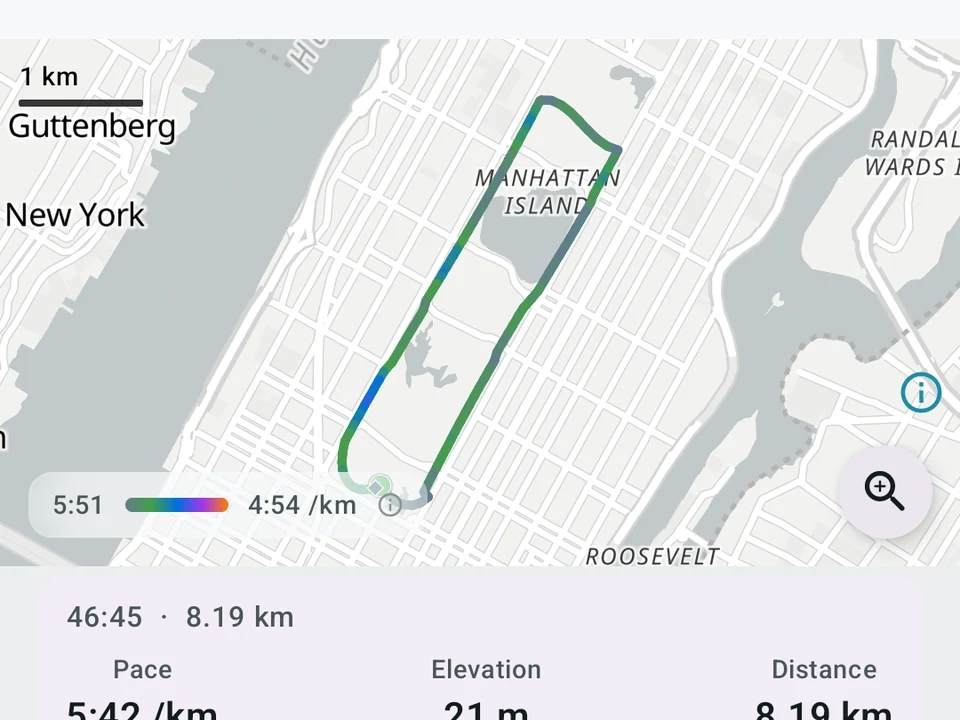
Real app capture, free tier. Run Studio colors an 8.19 km loop by pace, from 5:51 to 4:54 per km, above the time readout. Every chart and mark on this screen is free; the ghost compare of a second run is Pro.
One of the apps on this page
Kinoku is free to install
Core tracking works offline, with no account. An export from the app you use today can come along.
Android only for now, with an iPhone version in the works. Some depth is paid, and the pricing page says which parts.
Related features
A deep look at one run. Pace, heart rate, and climb on linked charts you can pinch to zoom. Tap the route to jump to that moment, and read marks for your peaks, fastest splits, and fatigue points. The whole screen is free. Pro adds replay, ghost-compare against another run, your own notes, and still-frame MP4 export.
Your run records and whether you are getting faster, over time. It reads your best efforts and a fitness estimate, never plain average pace, and only claims progress when the trend is sure.
Live pace, splits, a route map, and audio cues. Your run record is not uploaded to Kinoku; map tiles load when you view maps, and weather is a clear opt-in.
A multi-run map with All Time, 30 Days, 90 Days, and 1 Year filters, five basemap styles, whole-route average-pace colors, and snapshots to share.