

Best Strava alternatives (2026)
Three apps for runners leaving Strava's feed or subscription, ordered by account policy, with GPS recording, watch support and Strava import compared.
Activ.run and Kinoku record GPS runs with no account gate and no subscription wall on the core; Kinoku also reads a Strava archive and has a Wear OS app, while Runna sells a coached plan.
At a glance
| App | Best for | Better than Strava at | Main trade-off |
|---|---|---|---|
| Activ.run | Runners who lift and want a Garmin behind a light log, with no account gate | Garmin sync, FIT import and Strava account sync, with no subscription wall | Training plans are on its roadmap, and offline use is not stated |
| Kinoku | Runners who want the numbers kept on the phone, no account and no feed | No account, a Wear OS app, a Strava archive importer, and lifts in the same log | Android only for now, no feed, no segments, and the deeper run dashboard is Pro |
| Runna | Runners on a race plan who want a coach's schedule with GPS recording | A coached running plan, with strength sessions fitted around it | Its listing prints no plan terms, and its account policy is not stated |
Publisher disclosure
Kinoku, made by Dreamsoft Works, writes and publishes this page, and Kinoku is one of the apps on it. Every fact about another app is quoted from a page that app publishes, opened on September 20, 2026. We give no score. Where the list is ordered, the caption names the measure, and every label points at a quoted sentence.
Quickstart
Activ.run and Kinoku record GPS runs with no account gate and no subscription wall on the core, and Kinoku also reads a Strava archive and has a Wear OS app, while Runna sells a coached plan. The list is ordered by account policy, apps with no account gate first, and Runna sits last because its pages do not state one. Each label traces to a sentence from the app’s listing or site, and no score is given.
Why runners look for a Strava alternative
Strava is the social network for runners and riders, and its own support pages say why people stay: “Yes, Strava is a free app, and there is no cost to record and share your activities.” The same pages name three reasons a runner starts looking.
- The training layer needs a subscription: The support site lists “Fitness & Freshness”, the “Training Log”, leaderboards and offline route maps among subscriber features. Recording is free, and reading your own trends is not.
- The feed is the product: Strava’s sign-up page is where recording starts, and the app is built around sharing. A runner who wants the numbers without the audience carries the feed anyway.
- The data lives on a company server: The privacy policy says “your information will be transferred, processed, and stored in the United States.”
Strava’s pages print more than one subscription figure, so this page prints none.
Which Strava alternatives record runs with no account gate?
All three apps here record GPS runs themselves, so the list is ordered by account policy instead.
- No account gate: Activ.run’s homepage says “No account gate, no onboarding wall”, and its listing says “No subscription wall on the core features”. Kinoku asks for no account at all, and its run tracking is free.
- Not stated: Runna’s listing describes “a personal running coach in your pocket” and GPS tracking, and it does not state whether an account comes first.
Side by side
Each cell is a quote from the app’s listing or site, and “Not stated” marks a feature no page we could open mentions.
| App | Records GPS runs | Account | Social feed | Subscription | Watch | Strava history | Export |
|---|---|---|---|---|---|---|---|
| Activ.run | Yes (“live pace, distance, and time”) | No gate | Not stated | “No subscription wall on the core features” | Garmin sync | Account sync | CSV |
| Kinoku | Yes, free, with splits and a map | None | None | Free; deeper run dashboard is Pro | Wear OS app | Archive import, GPX routes | CSV, full ZIP backup |
| Runna | Yes (“map your route, distance … and pace”) | Not stated | Not stated | Not stated | “your compatible devices” | Not stated | Not stated |
Each app, in its own words
Activ.run
Best for: Runners who lift and want a Garmin behind a light log, with no account gate.
Activ.run is an Android app that answers the same question Kinoku does, one app for the lifts and the runs.
- What it does well: Its listing opens with “Activ.run is one app for your lifts and your runs.” The run side tracks “live pace, distance, and time”, and the listing says you can sync your Garmin watch, import FIT files and connect your Strava account so activities sync on their own. It also syncs with Google Health Connect and lists CSV export.
- What its pages say about limits: “Activ.run training plans are on the roadmap, not shipped.” Offline behaviour and a price are not stated on any page we could open.
- Where it is the better pick: A runner leaving Strava’s subscription who keeps a Garmin and wants the Strava account to keep syncing in the background.
- Where Activ.run differs: Its pages name Garmin sync rather than a watch app of its own, and steps and classes are not mentioned. Official listing: Google Play. Versus page: Kinoku vs Activ.run.
Kinoku
Best for: Runners who want the numbers kept on the phone, no account and no feed.
Kinoku is a private training app for Android that logs runs, lifts and steps with nothing sent to a Kinoku server.
- What it does well: Run tracking is free and complete: live pace and distance, splits, a route map, and audio cues for cadence, hills and heat. Running Progress adds best-effort records, a fitness estimate and trends for pace and distance. The Wear OS app starts a run from the wrist and tracks heart rate the whole time. The importer reads a Strava archive as a ZIP, GPX routes included, and lifts land in the same history as the runs on one fitness curve.
- What its pages say about limits: The deeper Run Analytics dashboard, Zone Training and the route heatmap are Pro, and so is laying two of your runs over each other in Run Studio, with a chart of where you led. Map tiles load over the network, weather is an opt-in call, and the Android system backup to your Google account is the one copy that can leave the phone.
- Where it is the better pick: A runner who wants Strava’s numbers without the feed, the subscription or the server, on an Android phone.
- What Kinoku does not do: Kinoku has no feed, no segments, no leaderboards and no route planner, and it has no iPhone or Apple Watch app yet. It reads no FIT files and runs no live sync with a Strava account or Garmin Connect.
Runna
Best for: Runners on a race plan who want a coach’s schedule with GPS recording.
Runna is a coaching app rather than a plain log, and it belongs here because it records runs itself.
- What it does well: Its listing says “Runna is a personal running coach in your pocket.” GPS tracking will “map your route, distance (in miles or kms) and pace”, and the plan includes “personalized strength and conditioning support that fits alongside your running plan”. You can “Follow all of your workouts on your compatible devices”.
- What its pages say about limits: The listing prints no price and no plan terms, and it does not state whether an account comes first, so this page states neither.
- Where it is the better pick: A runner leaving Strava who wants a plan written for a race date, with the strength work placed around the runs.
- Where Runna differs: It is a coached plan first, so a runner who writes their own sessions carries a plan they do not follow. Its pages state no Strava import and no feed either way. Official listing: Google Play.
Moving your Strava history
Strava’s support page says “Exporting your data is only available on the Strava website.” From the website you request a bulk archive, which arrives as a ZIP holding an activities spreadsheet and one route file per activity.
- On the Strava website, request the archive from your account settings and wait for the email.
- Save the ZIP to your phone or Google Drive as it is. There is no need to unzip it.
- In Kinoku, choose the file under Settings, then Backup & Import, then Import from other apps.
The import runs on the phone and reads each run’s distance, moving time, top heart rate and name from the spreadsheet, plus the route, pace and climb from each GPX file. The import costs nothing and takes as many activities as the archive holds, and Kinoku never logs in to Strava. The Strava Import page lists what comes across and what does not: FIT files are not read.
Activ.run takes the other route, a live sync with your Strava account, which keeps both apps in step but keeps the account. Runna’s pages state no Strava import.
When is Strava still the better pick?
You do not always need to leave, and Strava’s own pages make the case in three situations.
- Your friends are on the feed: Recording and sharing are free, and leaderboards come with the subscription. None of the apps here has a feed to replace that.
- You plan routes: Subscribers can download routes to their phone for offline use. Kinoku has no route planner, and Activ.run’s and Runna’s pages do not describe one.
- You run on an iPhone or an Apple Watch: Strava’s support pages cover Android, iOS, Wear OS 3 and above, Apple Watch and the web. Kinoku is Android and Wear OS only for now, and Activ.run’s site offers only a Google Play download.
How this list was checked
Every fact about another app is a sentence from its Google Play listing or its own site, opened on September 20, 2026.
- Public citations: Each competitor claim links to a support article, a legal page, a store listing or a homepage, cited by number in the sources aside.
- No emulator test: No emulator test was run for Activ.run or Runna, and none is cited for Strava on this page, so every cell is a quote or “Not stated”.
- Nobody paid: Account policy is the one thing that orders this list, and the app whose pages do not state one sits last.
Frequently asked questions
The questions runners ask before leaving Strava, answered from the apps’ own pages.
Is Strava free to use?
Yes, for recording. Strava’s support page says it is a free app and there is no cost to record and share your activities. A subscription adds the training layer, and the same support site lists Fitness & Freshness, the Training Log, leaderboards and offline route maps among subscriber features. We print no Strava price here, because Strava’s own pages showed more than one figure when we read them.
Which Strava alternatives work without an account?
Activ.run’s homepage says there is no account gate and no onboarding wall, so you can start a run without signing up. Kinoku asks for no account at all, and no Kinoku server holds the record. Runna’s listing describes a coach and a plan and does not state its account policy, so this page does not say. Strava’s own sign-up page is where recording starts.
Can I move my Strava history to another app?
Yes. Strava’s support page says exporting your data is only available on the Strava website, and from there you can request a bulk archive, which arrives as a ZIP with an activities spreadsheet and one route file per activity. Kinoku reads that ZIP as it is on the phone and takes the GPX routes inside it. Activ.run’s listing describes a live sync with your Strava account instead of an archive. Runna’s pages state no Strava import.
Which of these apps has a Wear OS app?
Kinoku does: the watch starts a run, tracks heart rate and shows splits, and it syncs to the phone on its own. Strava’s support page says it supports Wear OS 3.0 and above, and the same page lists Apple Watch. Activ.run’s pages name Garmin sync rather than a watch app of its own. Runna’s listing says you can follow your workouts on your compatible devices without naming them.
Which Strava alternatives have no social feed?
Kinoku has no feed, no followers and no segments, so nobody sees a run unless you share a card yourself. Activ.run’s and Runna’s listings describe a log and a coach and do not describe a feed, but they do not rule one out in a sentence we can quote, so the table says not stated for them. Strava is built around its feed, and its support site names leaderboards among subscriber features.
Do any of these apps record a run with no signal?
Strava’s support page says there is no data usage while recording unless you view maps or turn on its live features, and the app syncs the activity to Strava’s servers once you are back online. Kinoku records the run offline and keeps it on the phone, with no upload step, and its map tiles load over the network when you open the map afterwards. Activ.run’s and Runna’s pages do not state offline recording.
Which app is the pick for runners who also lift?
Activ.run and Kinoku both log gym sets and GPS runs in one app, and each is on the one-app roundup linked below. Kinoku also scores a gym session and a run on the same fitness curve, so the week’s load is one line. Runna’s listing says its strength and conditioning support fits alongside your running plan, which is a coached plan rather than a free-form gym log.
Does Kinoku read every file in a Strava archive?
Not yet. GPX route files come across with the route, pace and climb, and Kinoku unpacks the ones Strava ships gzipped, so old personal records show up on their true dates. Kinoku does not read FIT files, so an activity whose route only exists as FIT keeps its distance, time and heart rate from the spreadsheet and loses the map. The Strava Import page lists what comes across.
Which Strava alternative gives me training analytics for free?
Kinoku’s Running Progress is free: best-effort records, a fitness estimate, and trends for pace, distance and speed. The deeper Run Analytics dashboard with race-time forecasts and weekly training load is Pro, as is Zone Training. Strava puts Fitness & Freshness and the Training Log behind its subscription. Activ.run’s and Runna’s pages do not state which analytics are free.
Where does my run data live in each app?
Strava’s privacy policy says your information will be transferred, processed and stored in the United States. Kinoku does not upload your run history to a Kinoku server, so it stays on your phone, and the one copy that can leave is the Android system backup to your Google account. Activ.run’s and Runna’s pages we could open do not state where the log is kept.
Which app can sync with a Garmin watch?
Activ.run’s listing says you can sync your Garmin watch and import FIT files. Kinoku has its own Wear OS app and no Garmin Connect sync, and it does not read FIT files. Runna’s listing says you can follow your workouts on your compatible devices, without naming Garmin on the page we quoted. Strava’s support pages cover its own watch apps rather than Garmin on the article we cite.
What does Kinoku not do that Strava does?
Kinoku has no feed, no segments, no leaderboards and no route planner, and it runs on Android and Wear OS only, with no iPhone or Apple Watch app yet. It also has no website to sync a dead-zone run to later, because each run is saved on the phone and Kinoku has no server to send it to. Strava covers all of those, so a runner whose friends are on Strava, or who plans routes there, has a real reason to stay.
Related pages
- Kinoku vs Strava: The feed, the subscription and the archive, in detail.
- Best gamified fitness apps for Android: Strava’s challenges and badges beside six other apps that turn training into a game.
- Kinoku vs Activ.run: The two apps that log lifts and runs with no account gate.
- Best apps for lifting and running in one app: Strava beside the apps that keep both halves in one history.
- Best hybrid training apps for Android: Runna and the other plan-led apps for runners who lift.
- Strava Import: What Kinoku reads from a Strava archive and what it skips.
- Free run tracker apps with no account for Android: FitoTrack, OpenTracks and RunnerUp next to Kinoku, for runners who want no sign-up at all.
- Best Google Fit alternatives: Step and workout apps for Google Fit users, with each app’s account and Health Connect facts.
- Best Runkeeper alternatives: Six apps for Runkeeper users, grouped by which ones take Runkeeper’s GPX export.
- Free workout year in review apps: For people who came for Year in Sport, five recaps and the plan each one needs.
- Best apps to compare your runs on Android: For runners who used Strava to check progress, which apps line up two of your runs and which plan holds it.
- Best Nike Run Club alternatives: Seven run apps for Nike Run Club users, grouped by coached runs, a quiet GPS log or a social feed.
Which one fits you
- Choose Activ.run if you run and lift, you own a Garmin or want your Strava account to keep syncing, and you want the lightest log with no account gate.
- Choose Kinoku if you want your run history off a company server, no account, a Wear OS app, and your lifts and runs in one place, and you can live without a feed.
- Choose Runna if a race date drives your training and you want a coach's plan written for you, with GPS recording built in.
How this page is checked. Every fact about another app on this page comes from a page that app publishes, which we could open and quote on September 20, 2026. The sources, with the exact sentence each fact rests on, are listed just above. Every Kinoku fact is tied to the shipping app's code. The page carries no score; the caption above names the measure the list is ordered by. If a fact here has gone stale, the support page is the fastest way to tell us.
Kinoku in practice
Where this shows up in the app
 Open full-size image ↗
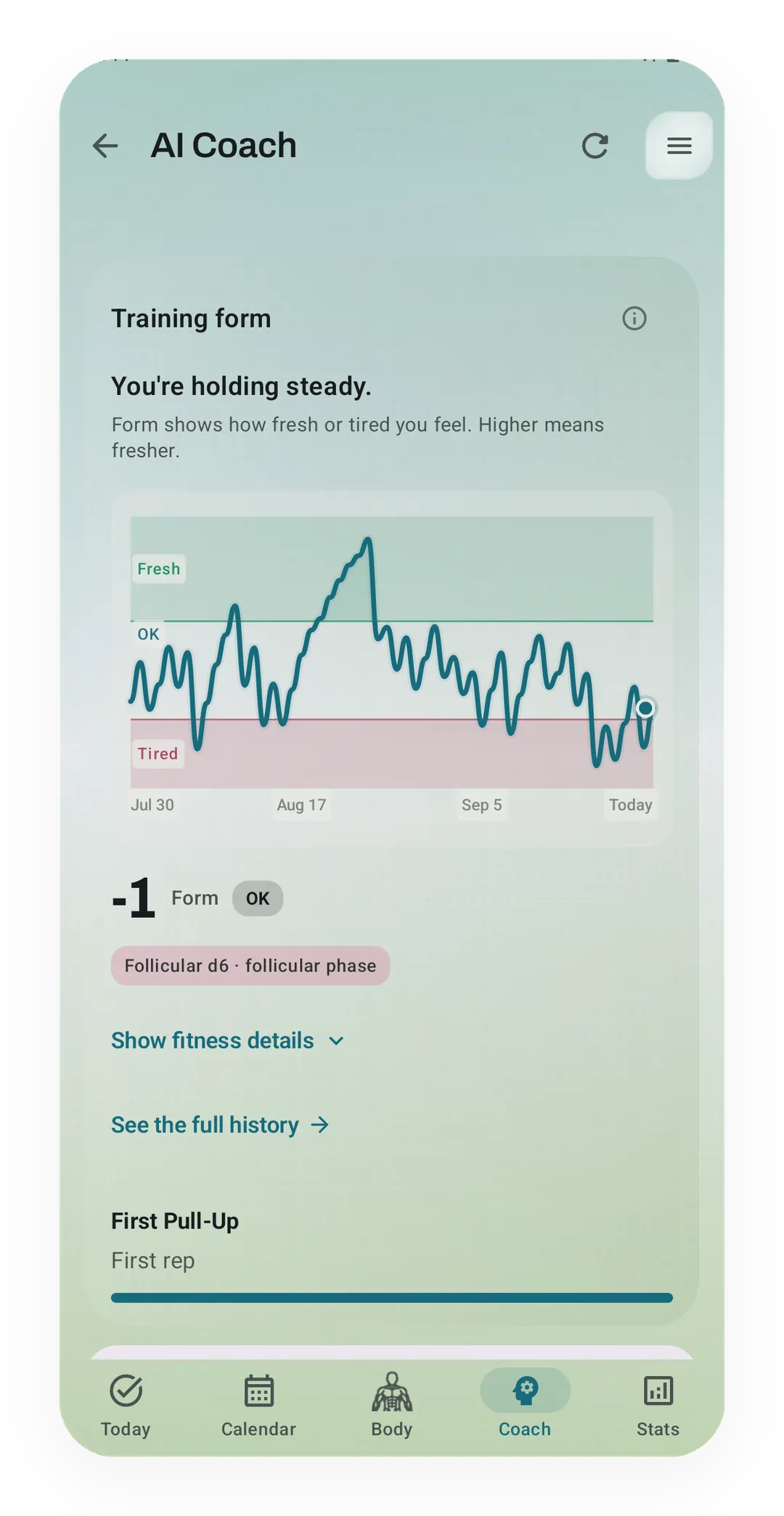
Runs and lifts on one form curve
Real app capture, free tier. The Form curve on Kinoku's Coach screen scores a run and a gym session in the same training stress units, so a runner who lifts sees the whole week as one line. Runs brought over from a Strava archive land on this curve too.
One of the apps on this page
Kinoku is free to install
Core tracking works offline, with no account. An export from the app you use today can come along.
Android only for now, with an iPhone version in the works. Some depth is paid, and the pricing page says which parts.
Related features
Live pace, splits, a route map, and audio cues. Your run record is not uploaded to Kinoku; map tiles load when you view maps, and weather is a clear opt-in.
Bring your Strava history with no login token. Choose the Strava archive ZIP once; Kinoku reads activities.csv and supported route files from it on your phone. Kinoku never touches Strava's servers.
Your run records and whether you are getting faster, over time. It reads your best efforts and a fitness estimate, never plain average pace, and only claims progress when the trend is sure.