
Best Nike Run Club alternatives (2026)
Seven Android running apps for Nike Run Club users, grouped by coached runs, a quiet GPS log or a social feed, with each maker's own words.
Nike Run Club pairs a free run tracker with Guided Runs and Training Plans, and invites you to become a Nike Member; adidas Running, ASICS Runkeeper and Runna also coach you, FitoTrack, Kinoku and OpenTracks log runs with no account named, and Strava adds a social feed.
At a glance
| App | Best for | Better than Nike Run Club at | Main trade-off |
|---|---|---|---|
| adidas Running | Runners who want a coach's plan up to the marathon and many sports in one app | A running coach with plans from 5K to marathon, interval training and two Wear OS tiles | Its listing carries the Contains ads label, and it names an adidas Running account |
| ASICS Runkeeper | Runners who liked NRC's coach audio and want guided workouts plus live location sharing | Audio-guided workouts from its coaches, race plans, live tracking and a shoe tracker | A OneASICS account on first open, ads, and full guided workouts sit in Runkeeper Go |
| FitoTrack | Runners who want an open-source log with voice announcements and no ads | Interval sets you build, voice announcements, and no data collected | Its pages describe no coach, no plans and no watch app |
| Kinoku | NRC runners who want free GPS runs with spoken splits, no account and a gym log | No account, spoken splits and interval steps, shoe mileage and a free Wear OS app | No coach-led audio runs, no race plans, no live location sharing and no NRC importer |
| OpenTracks | Runners who want a tracker that never goes online and pairs a heart rate strap | No internet access, voice announcements and Bluetooth heart rate sensors | Free on F-Droid, with no coach, plans or watch app named on its pages |
| Runna | Runners training for a race who want a plan that changes as they go | Plans from 5K to ultramarathon that update as you progress, plus strength sessions | Runna Premium follows a free trial, and its device list names no Wear OS watch |
| Strava | Runners who miss NRC's community and want a feed, challenges and segments | A feed of other athletes, segment leaderboards and a Wear OS app with a tile | An account is required, and some features sit in a paid subscription |
Publisher disclosure
Kinoku, made by Dreamsoft Works, writes and publishes this page, and Kinoku is one of the apps on it. Every fact about Nike Run Club and the other apps is quoted from a page that company publishes, opened on October 27, 2026. We ran no device test for this page. We give no score. The apps are grouped by what their own pages say they are built around, and every label points at a quoted sentence.
Quickstart
Nike Run Club (NRC) pairs a free run tracker with Guided Runs and Training Plans, and it invites you to become a Nike Member. Runna, Runkeeper and adidas Running also coach you, FitoTrack, Kinoku and OpenTracks keep a quiet log with no account named, and Strava adds a feed. Groups follow each app’s pages, A to Z, with no score.
What Nike Run Club gets right, and why people look elsewhere
NRC is a strong app, and its pages show why so many runners keep it. Its listing covers a free tracker for “GPS, elevation, heart rate & more”, Audio Guided Runs with Nike coaches and athletes “like Eliud Kipchoge”, and a “12-week” marathon plan. Nike’s own page adds a feature that lets your contacts see “your real-time location” while you run, and the listing says NRC “is supported on all Wear OS watches and many more, including Garmin”.
People still look around, and four lines on Nike’s and Google’s pages explain the usual reasons.
- A Nike account: The listing says “Download today to become a Nike Member and reach your goals with NRC.” It never states outright whether a run can be recorded before you join.
- Coaching by country: Training Plans are offered in nine countries the listing names, and Guided Runs “in select countries”, so the coaching that sets NRC apart may not reach you.
- A Google Fit link: “NRC works with Google Fit to sync workouts and record heart-rate data.” Google’s developer guide says the Google Fit APIs will be supported “until the end of 2026”, and no Nike page we read says what replaces that link.
- No export on the listing: The listing describes no way to take your runs out as files. Its data safety section does say “You can request that data be deleted”.
Which Nike Run Club alternatives coach you, and which only track?
The seven apps split by what their own pages say they are built around, so the first question is whether you used NRC for its coaches or only for the tracker.
- Coach-led runs or race plans named on its pages: adidas Running, ASICS Runkeeper (the running app from the shoe maker) and Runna. Each one names a coach, and each offers plans for a race.
- A GPS log that speaks your stats, with no account named: FitoTrack, Kinoku and OpenTracks. None of their pages names a coach in your ear or a sign-up.
- A feed of other runners: Strava. Its listing leads with a feed and segment leaderboards, which is the nearest match to NRC’s challenges and cheers.
Side by side
Every cell below is backed by a sentence from the app’s store listing, F-Droid page (an open-source app store), help centre or terms. Kinoku’s row comes from its own code, and “Not stated” means none of the pages we could open covers that point.
| App | Account | Coach or plans | Live location for others | Watch | Ads or paid layer |
|---|---|---|---|---|---|
| adidas Running | An adidas Running account is named | A running coach, plans from 5K to marathon | Not stated | Two Wear OS tiles | “Contains ads” label |
| ASICS Runkeeper | OneASICS sign-up or log-in on first open | Audio-guided workouts and race plans; full access in Runkeeper Go | Yes, listed under Runkeeper Go | Wear OS app in beta | “Contains ads” label; Runkeeper Go subscription |
| Runna | Not stated | Guided runs from its coaches; plans to ultramarathon | Not stated | Apple Watch, Garmin, Fitbit and others | Runna Premium after a free trial |
| FitoTrack | None named; “No data collected” | Interval sets you build | Not stated | Not stated | “neither advertisement nor tracking” |
| Kinoku | None | Interval sessions you build, read out step by step; no race plans | No | Free Wear OS app | No ads; deeper run dashboard is Pro |
| OpenTracks | None named; no internet access | Not stated | None, since it has no internet access | Not stated | “No ads.” |
| Strava | Required | Not stated | Not stated | Wear OS app with a tile | Free version and a subscription |
Each app, in its own words
adidas Running
Best for: Runners who want a coach’s plan up to the marathon and many sports in one app.
adidas Running is the adidas tracker for runs, rides and dozens of other sports, and its listing invites you to “Choose from 90+ sports & activities”.
- What it does well: Its plans come with a running coach, for distances from a 5K to a full marathon, and it offers “Interval training to boost speed and stamina”. During a run it follows heart rate, pace, calories and cadence. On a watch it adds two Wear OS tiles, one for six months of stats and one for starting an activity.
- What its pages say about limits: Google Play marks the listing “Contains ads”. Its watch section asks you to “Link your adidas Running account to your favorite wearable device”, so linking a watch uses an account.
- Where it is the better pick: An NRC runner who used the Training Plans most and also rides, hikes or swims.
- Where adidas Running differs: It has a social side as well, since the listing says you can “Follow other athletes, join sports clubs near you”. Official listing: Google Play.
ASICS Runkeeper
Best for: Runners who liked NRC’s coach audio and want guided workouts plus live location sharing.
ASICS Runkeeper is a GPS run tracker with coaching, and of the apps here its pages read closest to NRC’s mix of tracker, coach and plans.
- What it does well: Its coaches lead “audio-guided workouts for everything from your first 5K to interval training to mindfulness runs.” Its listing offers race plans, a Shoe Tracker for the miles on each pair, and Live Tracking that lets “approved contacts” see where you are.
- What its pages say about limits: The help centre says that on first open “you will be prompted to either sign up for a new OneASICS account or log in to an existing account.” Live Tracking, Premium Training Plans and full access to Guided Workouts are listed as Runkeeper Go features, and “Runkeeper Go is a subscription service.” The listing also carries the Contains ads label.
- Where it is the better pick: An NRC runner who wants a coach’s voice and a live map for family, and who is fine paying for the full set.
- Where ASICS Runkeeper differs: Its help centre says “The Runkeeper Wear OS app is currently in beta”. No Runkeeper page we read prints one price for Go, so this page prints none. Official listing: Google Play. More on it: Best Runkeeper alternatives.
Runna
Best for: Runners training for a race who want a plan that changes as they go.
Runna calls itself “a personal running coach in your pocket”, and its listing is built around training plans.
- What it does well: Its listing names plans for “5k, 10k, half marathon, marathon and ultramarathon”, and says “your Runna plan will continuously update to keep you on track.” The app gives you “guided runs from our expert coaches”, strength sessions that fit around the running, and GPS tracking of route, distance and pace.
- What its pages say about limits: “Following your free trial, subscribe to Runna Premium with a monthly or annual plan.” The listing prints no price, and we found no Runna page that states its account rule.
- Where it is the better pick: A runner with a race on the calendar who wants the plan to keep adjusting as their schedule and fitness change.
- Where Runna differs: Its device list names Apple Watch, Garmin, Suunto and Fitbit among others, and it does not name Wear OS. Official listing: Google Play.
FitoTrack
Best for: Runners who want a free, open-source log with voice announcements and no ads.
FitoTrack is an open-source workout tracker on Google Play, and its project wiki lists what it records and what it reads aloud.
- What it does well: Its wiki lists “Voice Announcements: be informed about your running workout”, and it lets you “create/edit/delete your own interval sets”. It also imports GPX route files, several at once, which helps if you saved runs from another app.
- What its pages say about limits: The listing says “There is neither advertisement nor tracking”, and its data safety section reads “No data collected”. It never uses the word account, so the lack of a sign-up is our reading of those lines.
- Where it is the better pick: An NRC runner who mostly wanted a clean tracker and would like one that collects nothing.
- Where FitoTrack differs: Its pages describe no coach, no race plans and no watch app. Official listing: Google Play.
Kinoku
Best for: NRC runners who want free GPS runs with spoken splits, no account and a gym log.
Kinoku is a private training app for Android that holds runs, gym sessions and daily steps in one history on the phone, with no account to make.
- What it does well: GPS runs are free, with live pace and distance, a map colored by pace, and voice cues that read out each kilometer or mile split. An interval session you build in the free Interval Editor is called out step by step, with a countdown into each change. Shoe mileage counts each pair for free, the free Wear OS app starts a run from the wrist, and Running Progress shows your best efforts over time.
- What its pages say about limits: The six-tab Run Analytics dashboard, race-time forecasts, pace zones, the route heatmap and run compare are Pro. The map needs a connection to load its tiles, and Android’s own system backup can copy your record to your Google account when you turn it on.
- Where it is the better pick: An NRC runner who used the tracker more than the coaches, wants no account, and lifts on the other days.
- What Kinoku does not do: It has no coach-led audio runs, no race plans, no live location sharing and no challenges with friends. It cannot read NRC runs, since its only importer for GPS routes takes a Strava archive, and it runs on Android only for now, with an iPhone version on the roadmap.
OpenTracks
Best for: Runners who want a tracker that never goes online and pairs a heart rate strap.
OpenTracks “Records as you go running or walking”, and its F-Droid page says it turns into a bike computer for rides.
- What it does well: Its feature list names “Voice announcements.” and Bluetooth sensors, including heart rate straps. It states “No Internet access or extra permissions.” and “No ads.”, so the app cannot send your runs over the internet by itself.
- What its pages say about limits: It is free on F-Droid, an open-source app store, and its pages name no coach, plans or watch app.
- Where it is the better pick: A runner who would rather the tracker had no way online at all, or who runs with a chest strap.
- Where OpenTracks differs: With no internet access, it shares nothing live, so a family map like NRC’s is not on offer. Official listing: F-Droid.
Strava
Best for: Runners who miss NRC’s community and want a feed, challenges and segments.
Strava is built around a feed of other people’s efforts, and of the apps here it is the closest match to NRC’s challenges and cheers.
- What it does well: Its listing says “Your Strava feed is filled with real efforts from real people.” Its segments let you “Race against others” for a place on the leaderboards, and its Wear OS app has a tile and a complication that start an activity.
- What its pages say about limits: Its terms make an account a condition of using the service at all. Strava’s support page says recording and sharing are free, and the listing names “a subscription version with premium features” beside it.
- Where it is the better pick: An NRC runner whose friends already post on Strava and who runs for the community as much as the miles.
- Where Strava differs: It is the one app here built around other people’s runs, and this page prints no price for its subscription. Official listing: Google Play. Versus page: Kinoku vs Strava.
Leaving Nike Run Club with your runs
Taking years of runs out of NRC is the weak spot on every page we read, so plan for it before you switch.
- From Nike’s side: The listing mentions no export. Nike’s help articles load only in a browser script, so we could not quote them here, and we make no claim about what they offer.
- Into Kinoku: Kinoku cannot import NRC runs. Its Health Connect link imports runs that other apps saved there in the past seven days, but NRC’s listing names Google Fit, not Health Connect, so we cannot say NRC runs would arrive that way.
- Into the open-source apps: FitoTrack reads GPX route files, but no Nike page we read says NRC gives you those.
The low-risk path is to keep NRC installed for your history and start fresh in the new app, so your old runs stay where they are while you try it.
When is Nike Run Club still the better pick?
NRC keeps the edge in a few cases, and its own pages make each one.
- You run with Guided Runs: Nike’s page invites you to “let a Nike Running Coach guide your run”, and Runkeeper’s audio-guided workouts come closest here, with Runna’s coach-led guided runs next to them.
- You train on its plans: If you live in one of the nine countries with Training Plans, the 12-week marathon plan sits inside the same app as your tracker.
- Your friends are there: The listing lets you “create one and invite your friends” for a challenge and send “in-run audio cheers”, and moving apps leaves that group behind.
For a runner who mostly used NRC as a tracker, a quieter log loses little, while a runner who leans on the coaches gives up the part that made NRC special.
How this list was checked
All facts about the other apps, Nike’s included, come from pages their makers publish, opened on October 27, 2026.
- Nike’s pages: Each line about NRC is quoted from its Google Play listing or Nike’s NRC page. Nike’s help articles render only in a browser script, so none of them is quoted.
- Other apps: Each fact is a sentence from a store listing, an F-Droid page, a help centre, a wiki or a terms page. We ran no device test, and a cell with no sentence behind it reads “Not stated”.
- Kinoku: Kinoku’s lines were checked against the app’s code, including which run views are Pro and what its voice cues say.
- Order: The coaching apps come first, then the quiet logs, then the social app, sorted A to Z inside each group, and none of the makers paid for a place.
Frequently asked questions
Is there a free alternative to Nike Run Club?
Yes, several record runs at no cost. FitoTrack and OpenTracks are open source with no ads, and Kinoku’s GPS runs, spoken splits and interval sessions are free with no ads either. Strava says recording and sharing cost nothing, with a paid tier beside it. The adidas Running and ASICS Runkeeper listings carry the Contains ads label, and Runkeeper also sells Runkeeper Go.
Which Nike Run Club alternative has a coach talking in my ear?
ASICS Runkeeper is the closest match on its own pages: its coaches lead audio-guided workouts from a first 5K to interval runs, with full access in Runkeeper Go. Runna’s listing says it gives you guided runs from its coaches, and adidas Running names a running coach with plans. FitoTrack, Kinoku and OpenTracks read out your stats, and none of their pages names coach-led audio.
Do I need an account to use these apps?
It depends on the app. Strava’s terms require one, and Runkeeper’s help centre says the app asks you to sign up for OneASICS or log in. The adidas Running listing names an adidas Running account. Kinoku has no account at all, while FitoTrack declares no data collected and OpenTracks has no internet access, so neither names a sign-up. Runna’s pages we read do not say.
Can I move my Nike Run Club history to another app?
Not by any route Nike’s listing names. It mentions no export and no import, and Nike’s help pages load only in a browser script, so we could not quote them. Its data safety section says you can ask Nike to delete your data. Kinoku cannot import NRC runs. FitoTrack reads GPX route files, but no Nike page we read says NRC hands you those.
Will Nike Run Club keep syncing with Google Fit?
The NRC listing says it works with Google Fit to sync workouts and heart rate. Google’s developer guide says the Google Fit APIs, the hooks other apps use, will be supported until the end of 2026. No Nike page we could read says what NRC will sync with after that. Kinoku reads and writes through Health Connect, which the same guide names as the path for apps that live on the phone.
Which alternative has a plan for a marathon?
adidas Running names plans from 5K up to the marathon, and Runna lists plans up to the ultramarathon that update as you go. ASICS Runkeeper offers a personalized training plan for your next race, with Premium Training Plans in Runkeeper Go. FitoTrack, Kinoku, OpenTracks and Strava name no race plans on the pages we read, so NRC’s own 12-week plan stays a strong pick.
Which Nike Run Club alternatives work on a Wear OS watch?
Strava’s Wear OS app has a tile and a complication for starting an activity, and adidas Running offers two Wear OS tiles. Kinoku’s Wear OS app is free and starts a run from the wrist. Runkeeper says its Wear OS app is in beta. Runna lists Apple Watch, Garmin, Suunto and Fitbit, and the FitoTrack and OpenTracks pages name no watch app.
Which alternative tracks the miles on my running shoes?
ASICS Runkeeper has a Shoe Tracker that keeps the mileage on each pair, much like NRC’s shoe tagging. Kinoku’s shoe mileage is free, adds each run to your default pair, and warns as a pair nears the target you set. The other apps on this page do not name shoe tracking on the pages we read.
Which Nike Run Club alternative has no ads?
FitoTrack says there is neither advertisement nor tracking, OpenTracks lists no ads on its F-Droid page, and Kinoku shows no ads on any plan. The adidas Running and ASICS Runkeeper listings carry the Contains ads label. Runna and Strava list paid tiers, and neither listing carries that label on the day we checked.
Which alternative lets my family see where I am on a run?
ASICS Runkeeper is the one here that names it: its Live Tracking shares your location with approved contacts, and its help centre lists Live Tracking among Runkeeper Go features. NRC has its own run location sharing too. Kinoku has no live location sharing, and the pages we read for the other apps do not name it.
Does Kinoku have guided runs like Nike Run Club?
No. Kinoku has no coach-led audio runs. Its voice cues read out each kilometer or mile split with your pace, and an interval session you build in the free Interval Editor is called out step by step with a countdown. So it speaks your numbers and your plan, but no coach talks you through the run.
What does Kinoku not do that Nike Run Club does?
Kinoku has no Guided Runs, no race training plans, no live location sharing, no friend challenges or audio cheers and no community feed. It cannot import NRC runs, and it runs on Android only, with an iPhone version on the roadmap. The deeper run dashboard, race forecasts, pace zones and run compare are Pro, while recording runs stays free.
Related pages
- Best Runkeeper alternatives: Run trackers grouped by whether they take Runkeeper’s exported GPX files.
- Best Strava alternatives: For runners who want to leave Strava’s feed or subscription.
- Free run tracker apps with no account: Sign-up rules, export and watch support in five Android run apps.
- Best apps for lifting and running in one app: Which apps keep gym sets and GPS runs in one history.
- Kinoku vs Strava: A no-account log next to a social network for runners.
- GPS runs: Live pace, splits, the route map and audio cues on the free plan.
- Interval Editor: Build your own run intervals step by step.
- Shoe mileage: Wear-out targets for each pair of running shoes.
Which one fits you
- Choose adidas Running if you want a coach's plan for a 5K or a marathon, you also ride or hike, and ads do not bother you.
- Choose ASICS Runkeeper if you want coach audio in your ear and family watching your run live, and a OneASICS account is fine.
- Choose Runna if you have a race date and want a plan that keeps updating as you go, and a subscription after the trial is fine.
- Choose FitoTrack if you want a free open-source log that speaks your stats, and you build your own intervals.
- Choose Kinoku if you want free GPS runs with spoken splits and no account, you lift too, and you can leave your NRC history behind.
- Choose OpenTracks if you want a log that cannot reach the internet, you pair a heart rate strap, and you install from F-Droid.
- Choose Strava if your running friends already post on Strava and you miss the challenges and the community.
How this page is checked. Every fact about another app on this page comes from a page that app publishes, which we could open and quote on October 27, 2026. The sources, with the exact sentence each fact rests on, are listed just above. Every Kinoku fact is tied to the shipping app's code. The page carries no score; the apps are grouped by what their own pages say. If a fact here has gone stale, the support page is the fastest way to tell us.
Kinoku in practice
Where this shows up in the app
 Open full-size image ↗
A finished run, free tier
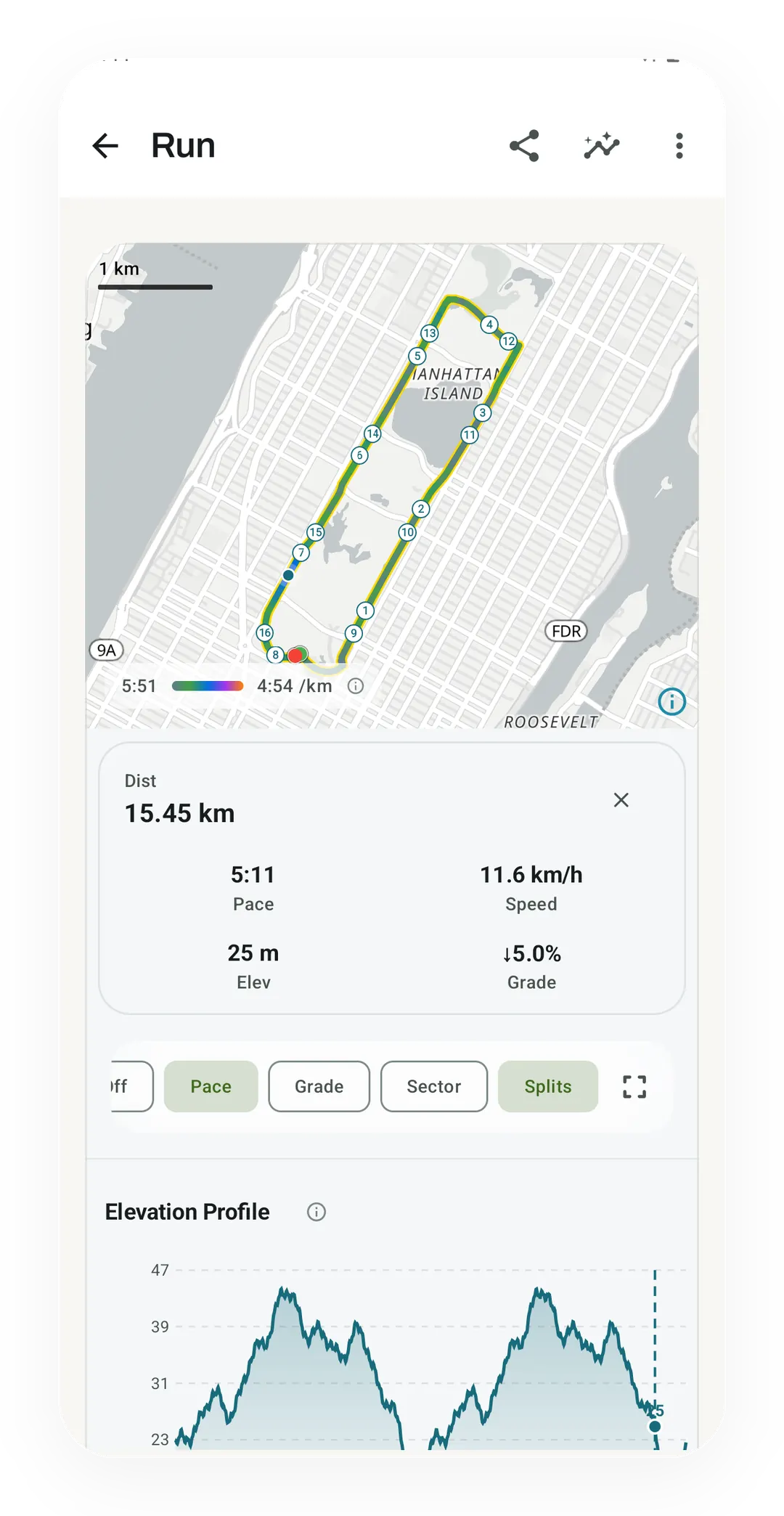
Demo data, not a real run. A free-tier run screen with the route colored by pace from 5:51 to 4:54 per kilometer, numbered kilometer splits on the map, 15.45 km at 5:11 pace, and the elevation profile under it.
One of the apps on this page
Kinoku is free to install
Core tracking works offline, with no account. An export from the app you use today can come along.
Android only for now, with an iPhone version in the works. Some depth is paid, and the pricing page says which parts.
Related features
Live pace, splits, a route map, and audio cues. Your run record is not uploaded to Kinoku; map tiles load when you view maps, and weather is a clear opt-in.
Build custom interval workouts step by step: warm-up, work, recovery, and repeats. Or copy a built-in one and tune it.
Tracks the life of your running shoes, with wear-out targets and data that survives a new phone.
A real watch app for workouts, runs, steps, tiles, and watch face data.
Your run records and whether you are getting faster, over time. It reads your best efforts and a fitness estimate, never plain average pace, and only claims progress when the trend is sure.