

Beginner Workout Routine at Home: Pick a Free Plan
A beginner workout routine at home depends on your gear. Match bodyweight, dumbbells or a barbell to a free plan, with its days a week and who it is for.
Kinoku in practice
Where this shows up in the app
 Open full-size image ↗
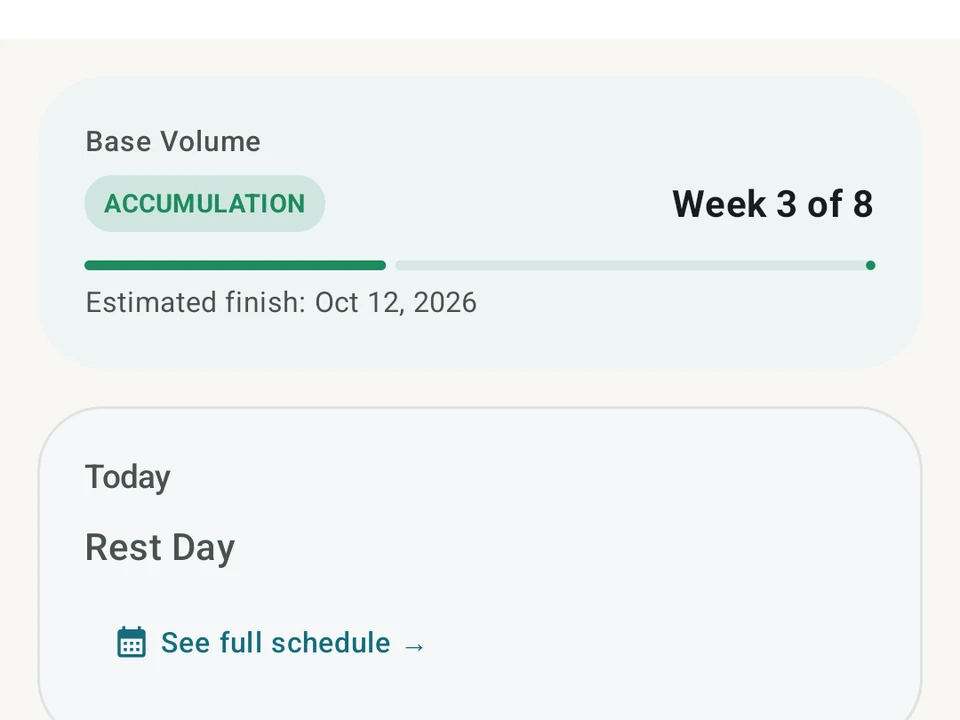
A plan that counts its weeks
App capture of the program dashboard, from an 8-week template. Each of the four plans on this page counts its 12 weeks on the same card.
 Open full-size image ↗
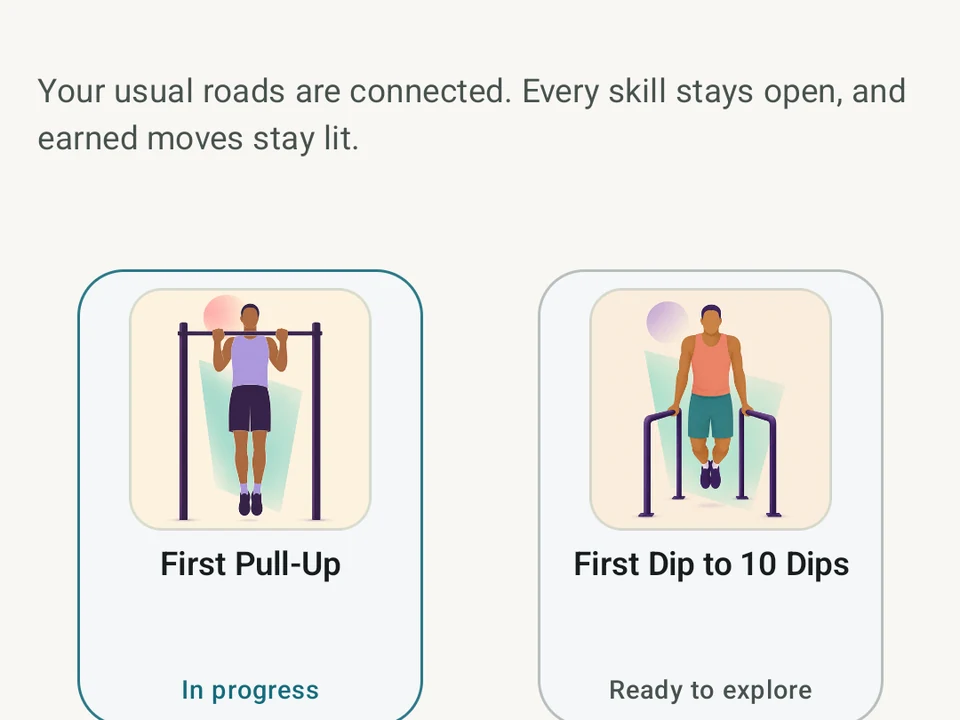
Skill Journeys beside a bodyweight plan
App capture of the Skill Board. First Pull-Up and First Dip to 10 Dips are free journeys that can run beside the Recommended Routine.
Quickstart
A beginner workout routine at home comes down to the gear you own, and each kind of home setup below has a free plan in Kinoku.
| Your gear at home | Days a week | Plan | Listed for |
|---|---|---|---|
| No weights: a pull-up bar, something to dip on and something low to row under | 3 | Bodyweight Recommended Routine | Beginners |
| Dumbbells that change weight in small steps (Kinoku’s version adds a flat bench) | 3 | Dumbbell Stopgap | Beginners |
| The same dumbbells and bench, with six days free | 6 | Dumbbell PPL (push, pull, legs) | Intermediate lifters |
| A barbell, plates, a rack and a bench | 3 | Basic Beginner Routine | Beginners |
Each plan name links to its own page, which lists every set and the steps to start the plan in the app.
Why your gear picks the plan
Each of these plans makes the work harder in its own way, so the gear you own decides which one can keep moving forward. A bodyweight plan moves to a harder version of each move, a dumbbell plan moves to heavier dumbbells, and a barbell plan adds small plates to the bar.
Kinoku sorts its templates by gear the same way. A barbell setup also covers the dumbbell and bodyweight plans, and dumbbells cover the bodyweight plans, but not the other way round.
No weights: the Recommended Routine
The Recommended Routine is a full-body plan from the r/bodyweightfitness community on Reddit, kept on the community’s wiki. It runs three days a week with a rest day between. Each session pairs a pull-up with a squat, a dip with a hinge and a row with a push-up, then ends with a short block of core work.
The gear list is short. The wiki treats rows as the one move nobody skips, and it suggests a low bar, rings or a sturdy table to row from. Two sturdy chairs or the corner of a kitchen counter can stand in for dip bars.
Every move is a ladder of easier and harder versions. A step begins at 3 sets of 5 and adds a rep to each set every session. Once 3 sets of 8 are clean, the next version takes its place.
Kinoku’s template plans one routine on Monday, Wednesday and Friday for 12 weeks, with eight moves in the wiki’s pair order. It sets no rep climb, so its targets stay at 3 sets of 5 until you edit the routine and swap in the next version. If a first pull-up is the goal, the free First Pull-Up journey in Skill Journeys can run beside it.
Dumbbells and a bench: the Dumbbell Stopgap
The Dumbbell Stopgap is a three-day plan that a Reddit user, u/Cammorak, posted to r/Fitness for lifters with dumbbells and no barbell. The Fitness Wiki keeps the post in its archive, and the author is clear about the gear: “This program is not for people with a single pair of fixed-weight dumbbells”. The plan moves up one dumbbell at a time, so it works with a range of dumbbells or a pair that adjusts.
Kinoku’s version is its own take, since the original post takes turns between two workouts and presses from the floor. Kinoku runs one full-body routine on Monday, Wednesday and Friday. It holds five dumbbell lifts at 3 sets of 8, which are a goblet squat, a Romanian deadlift, a bench press, a one-arm row and a shoulder press. Three planks of 45 seconds close it out.
Take a dumbbell bench press with 14 kg dumbbells as an example. Each good session adds a rep to the target, from 8 up to 12. After 3 sets of 12, the next session plans 16 kg dumbbells for sets of 8. A lift left blank at the start begins at 7.5 kg a dumbbell.
The name says the plan is a bridge to something else. The post says “This program has a relatively short shelf life”, because it ends once your dumbbells run out.
Six days with dumbbells: Dumbbell PPL
Dumbbell PPL is a layout of Kinoku’s own, with push on Monday and Thursday, pull on Tuesday and Friday and legs on Wednesday and Saturday. It uses the same five main lifts as the Stopgap and the same climb from 8 to 12 reps before the dumbbells go up 2 kg.
Kinoku lists it for intermediate lifters, and six sessions a week leave little slack, since a skipped day shows as missed and the plan does not shift. A newer lifter with the same dumbbells can begin with the Stopgap and move to Dumbbell PPL later.
When the Basic Beginner Routine fits better
A home gym with a barbell, plates, a rack and a bench opens up the Basic Beginner Routine, and so does a commercial gym. The Fitness Wiki says “This routine is for anyone who is a complete beginner to strength training using barbells”, and it calls the plan a “training wheels” routine.
It takes turns between two workouts on three days a week, with rows, bench press and squats one day and chin-ups, overhead press and deadlifts the next. Each lift gets 3 sets of 5 with the last set taken further. In Kinoku, the first working weight is 80 percent of the one-rep max you enter, and a field left blank starts on the empty 20 kg bar, or at bodyweight for chin-ups.
The wiki suggests three months at most, and for the next step it names “either GZCLP or 5/3/1 for Beginners”, the programs of Cody Lefever and Jim Wendler. Kinoku has a GZCLP template, and its 5/3/1 templates are Boring But Big and nSuns, not 5/3/1 for Beginners.
How to pick one in Kinoku
The program finder asks four questions, about your level, your days, your goal and your gear. The gear choices are Full gym, Dumbbells and Bodyweight, and the finder then shows a pick with the reasons behind it. Like the templates, the finder is free, and each program page above also shows how to start its template by hand.
What these plans leave out
Kinoku plans the sessions and logs what you lift, so a few things stay with you.
- Kinoku’s Recommended Routine has no warm-up, while the wiki’s session opens with 5 to 10 minutes of one.
- The Basic Beginner Routine asks for cardio on at least two days a week, and Kinoku’s plan holds only the lifting days.
- The Stopgap and Dumbbell PPL plan in fixed 2 kg steps, so a rack that moves in 2.5 kg steps means picking the nearest pair.
- Kinoku does not watch your form.
- Kinoku runs on Android only.
If you are pregnant, injured or have a health condition, a talk with a doctor before a new routine is the safer choice.
For a no-gear session built from the Army’s own drills, the military calisthenics workout page lists every move and count.
Common questions
What is a good beginner workout routine at home?
The right one depends on the gear you have at home. With no weights, the Bodyweight Recommended Routine trains three days a week with pull-ups, dips, rows, squats and push-ups. With dumbbells that change in small steps, Kinoku's version of the three-day Dumbbell Stopgap adds reps from 8 to 12 before the weight goes up. Both are free templates in Kinoku.
Can I do a beginner workout at home with no equipment?
Yes, the Recommended Routine from r/bodyweightfitness needs no weights, only a few things to hold on to. It rows from a low bar, rings or a sturdy table, and two sturdy chairs or the corner of a kitchen counter can stand in for dip bars. Progress comes from a harder version of each move instead of more weight.
What if I have only one pair of dumbbells?
The Dumbbell Stopgap's author wrote that it is not for a single pair of fixed-weight dumbbells, because the plan moves up one dumbbell at a time. With one pair, the bodyweight Recommended Routine is the plan here that does not depend on heavier weights, since a harder version of each move takes their place.
How many days a week do these plans train?
Three of the four train three days a week with a rest day between, which are the Recommended Routine, the Dumbbell Stopgap and the Basic Beginner Routine. Dumbbell PPL (push, pull, legs) trains six days, from Monday to Saturday, and Kinoku lists it for intermediate lifters.
Are these home workout plans free in Kinoku?
Yes, all four are free templates in Kinoku, with no cap on how many programs you keep, and they run offline on Android with no account. The program finder that suggests one from your answers is free as well.
Track this in the app
Periodization
A 4-phase planning stack. The builder, all 25 templates, named programs with auto-progression, the custom model, and unlimited active programs are free. Pro adds volume targets, readiness tuning, and auto set changes.
Core tracking works offline, with no mandatory account.
Related features
A 4-phase planning stack. The builder, all 25 templates, named programs with auto-progression, the custom model, and unlimited active programs are free. Pro adds volume targets, readiness tuning, and auto set changes.
Unlimited routines, Smart Sync, Starter Packs, and follow-along links are free, and so are Rotation Groups that cycle through several routines for you.
Seven free, offline-first paths to named bodyweight skills, with editable routines, evidence-based progress, graduation receipts, and no active-journey cap.
Plan workouts on one calendar, with no limit on how many plans you keep or how far ahead you plan. Pro adds repeating schedules (weekly, custom days, or every few weeks), drag-to-move, bring-to-today, repeat-day, and day copy.
1,300+ built-in exercises with muscle data and unlimited custom moves are free. Pro adds custom form photos and assisted sorting.